Category: Uncategorized

  • How to Specify Pickleball Grip Size and Handle Length (Before You Order)

    How to Specify Pickleball Grip Size and Handle Length (Before You Order)

    Players will argue for an hour about core thickness and face material, then pick a grip size by grabbing whatever paddle is on the rack. That is backwards. Grip circumference and handle length are the two specifications your hand actually touches on every shot, and getting them wrong quietly undermines control, invites arm fatigue, and in the worst case contributes to elbow pain. If you are ordering paddles for yourself, a club, or a branded run, these two numbers deserve a deliberate decision. Here is how to make it.

    Why grip size is the fit decision most buyers skip

    Grip size is the circumference of the handle, measured around the octagonal cross-section, and it runs in a surprisingly narrow band. The common range spans just 4.0 to 4.625 inches, stepped in eighth-inch increments: Size 0 at 4.0, Size 1 at 4.125, Size 2 at 4.25, and on up to Size 5 at 4.625. Size 2, at 4.25 inches, is the default most manufacturers ship, which is exactly why so many players end up on it by accident rather than by fit.

    The stakes are higher than the small numbers suggest. A grip that is too large forces your hand to stay partly open, which reduces wrist mobility and control on touch shots at the net. A grip that is too small encourages you to squeeze harder to keep the paddle from twisting, and that constant over-gripping is a classic contributor to tennis-elbow-style strain. The right size lets you hold the paddle firmly without clenching, which is the foundation for both spin and a soft dink.
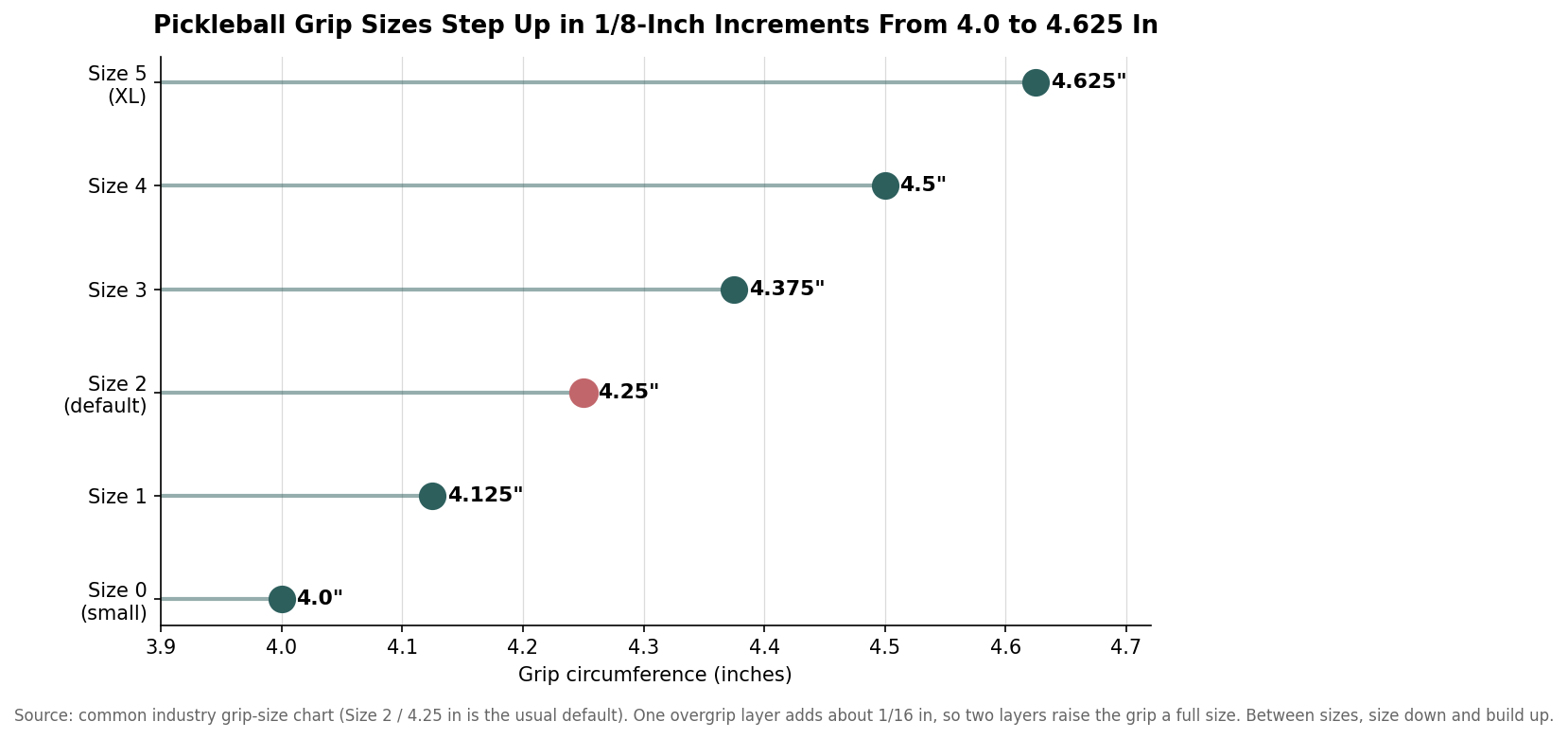
    Dot plot of pickleball grip sizes from Size 0 at 4.0 inches to Size 5 at 4.625 inches in eighth-inch steps
    Pickleball grip sizes run in eighth-inch steps from 4.0 to 4.625 inches; Size 2 (4.25 in) is the common default.

    Two ways to measure the right circumference

    The ruler test is the most accurate starting point. Hold your dominant hand palm-up with the fingers extended and pressed together. Measure from the middle crease of your palm, the second major horizontal line up from your wrist, straight to the tip of your ring finger. That distance in inches is a strong estimate of your ideal grip circumference. Most adult hands land somewhere between 4.0 and 4.5 inches, which is why the whole size ladder is so compressed.

    The index-finger test confirms the fit on an actual paddle. Take a normal grip, then try to slide the index finger of your non-hitting hand into the gap between your fingertips and the base of your thumb. If it fits snugly with light contact on both sides, the size is right. If there is no room, the grip is too small; if the finger slides in with space to spare, the grip is too large. Between the two methods, measure first to narrow the choice, then handle a paddle to confirm.

    Sizing between two numbers: go down, then build up

    Because the increments are so fine, plenty of players measure to a value that sits between two listed sizes. The rule in that situation is to size down. The reason is purely mechanical: you can always add circumference, but you can never remove it. An overgrip layer adds roughly one-sixteenth of an inch, so two wraps raise the grip by about an eighth of an inch, which is one full size on this ladder. A player who buys the smaller size retains the ability to dial the fit upward with one or two overgrips and to refresh the tackiness whenever it wears. A player who buys too large has no equivalent move short of replacing the grip entirely.

    This matters for custom and bulk orders too. If you are speccing paddles for a club or a giveaway where hands vary, ordering closer to the default 4.25-inch size and letting recipients personalize upward with overgrips is usually smarter than guessing large. It keeps the base paddle usable for the widest range of players.

    Handle length is a separate decision from grip size

    Grip circumference is about how thick the handle is; handle length is about how long it is, and the two move independently. Handles generally fall into three bands. Short handles run under 5 inches and shift weight toward the head for a punchier feel. Standard handles sit around 5 to 5.25 inches and suit most one-handed players. Long handles reach 5.25 to 5.5 inches and beyond, with some models pushing toward 6.

    The decisive question is whether you hit a two-handed backhand. That stroke needs enough handle to seat both hands without the lower hand spilling onto the paddle face, which in practice means a handle of at least 5.25 to 5.5 inches. Anything shorter forces the off hand onto the hitting surface, costing control and feeling awkward. A longer handle also acts as a longer lever, adding a little head speed and moving the balance point toward your hand for a more maneuverable, head-light feel.

    There is a real trade-off on the other side. Under USA Pickleball rules, a legal paddle’s combined length and width cannot exceed 24 inches, and total length is capped at 17 inches, so every inch you add to the handle is an inch subtracted from the hitting face. The chart below illustrates the relationship on a representative sixteen-inch paddle: a 4.5-inch handle leaves roughly 11.5 inches of face, while a 5.5-inch handle leaves closer to 10.5. A shorter face means a smaller and slightly lower sweet spot, which is the price a two-handed player pays for room to hold on.
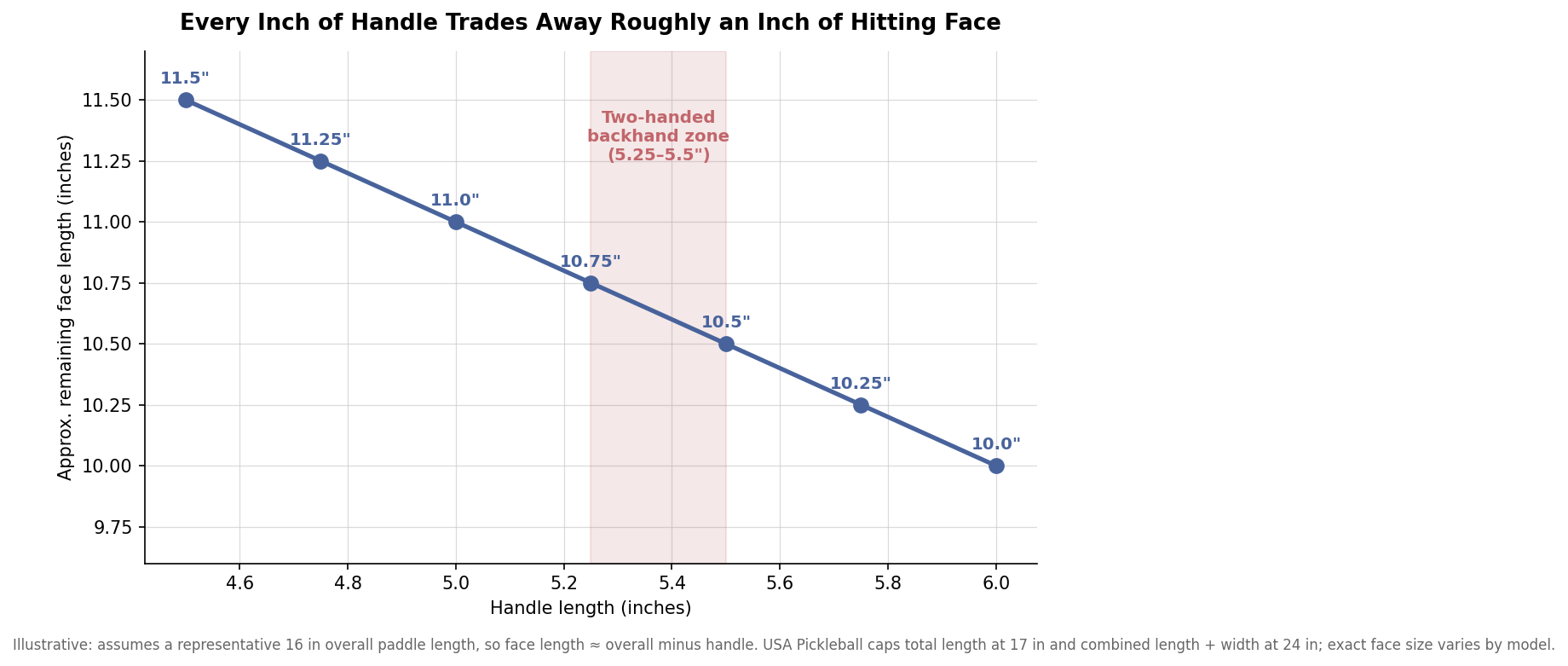
    Line chart showing remaining paddle face length falling as handle length rises, with a two-handed backhand zone marked
    On a representative 16-inch paddle, each inch of handle trades away about an inch of hitting face.

    Specifying grip and handle for a custom order

    Decide the two numbers before anything cosmetic. Settle grip circumference by measuring the intended player’s hand or, for a mixed group, defaulting to 4.25 inches with the expectation that overgrips will fine-tune it. Settle handle length by asking a single question: does this player, or this population of players, hit two-handed backhands? If yes, spec 5.25 inches or longer and accept the modestly shorter face. If the group is mostly one-handed and values a larger sweet spot, a standard handle around 5 inches serves them better.

    Only once those are fixed does the rest of the build make sense, because grip and handle interact with everything else you choose. A long handle paired with a head-heavy weight will feel very different from the same handle on a head-light paddle, and a small grip on a heavy paddle magnifies twisting forces on off-center hits. Lock the fit dimensions first, confirm them against a real sample in hand, and the paddle you order will play the way you intended rather than the way the default rack happened to be set up.
  • Pickleball Paddle Weight: How Light, Mid, and Heavy Actually Play

    Pickleball Paddle Weight: How Light, Mid, and Heavy Actually Play

    Ask two pickleball players what makes a paddle good and one will say power while the other says control, and both are really talking about weight. It is the single specification that touches everything else: how hard you can drive a ball, how fast your hands are at the net, how stable the paddle stays on a mishit, and how your elbow feels after three games. Face material and shape matter, but weight is the one you feel on the very first swing, and it is the easiest to get wrong when ordering paddles you have not held.

    This is a head-to-head look at how light, mid, and heavy paddles actually play, so you can put a number on the tradeoff before you commit, whether you are buying one paddle or speccing a batch for a club.

    The three weight classes, and where most paddles sit

    Paddle weight is measured in ounces, and while the exact cutoffs vary from one guide to the next, the working bands are consistent enough to use. Lightweight paddles come in under about 7.8 ounces, midweight paddles fall roughly between 7.8 and 8.4 ounces, and heavyweight paddles run above 8.4. The center of gravity for the whole market sits in the midweight band, and the single most common spec is a midweight around 8.0 ounces, which is where most players and most stock paddles land for a reason.

    Treat those numbers as bands, not walls. One brand’s 7.8-ounce paddle can feel livelier than another’s because the mass is distributed differently, which is why two paddles on the same scale reading can play nothing alike. The class tells you the neighborhood; it does not tell you the exact address.

    What weight buys you, and what it costs

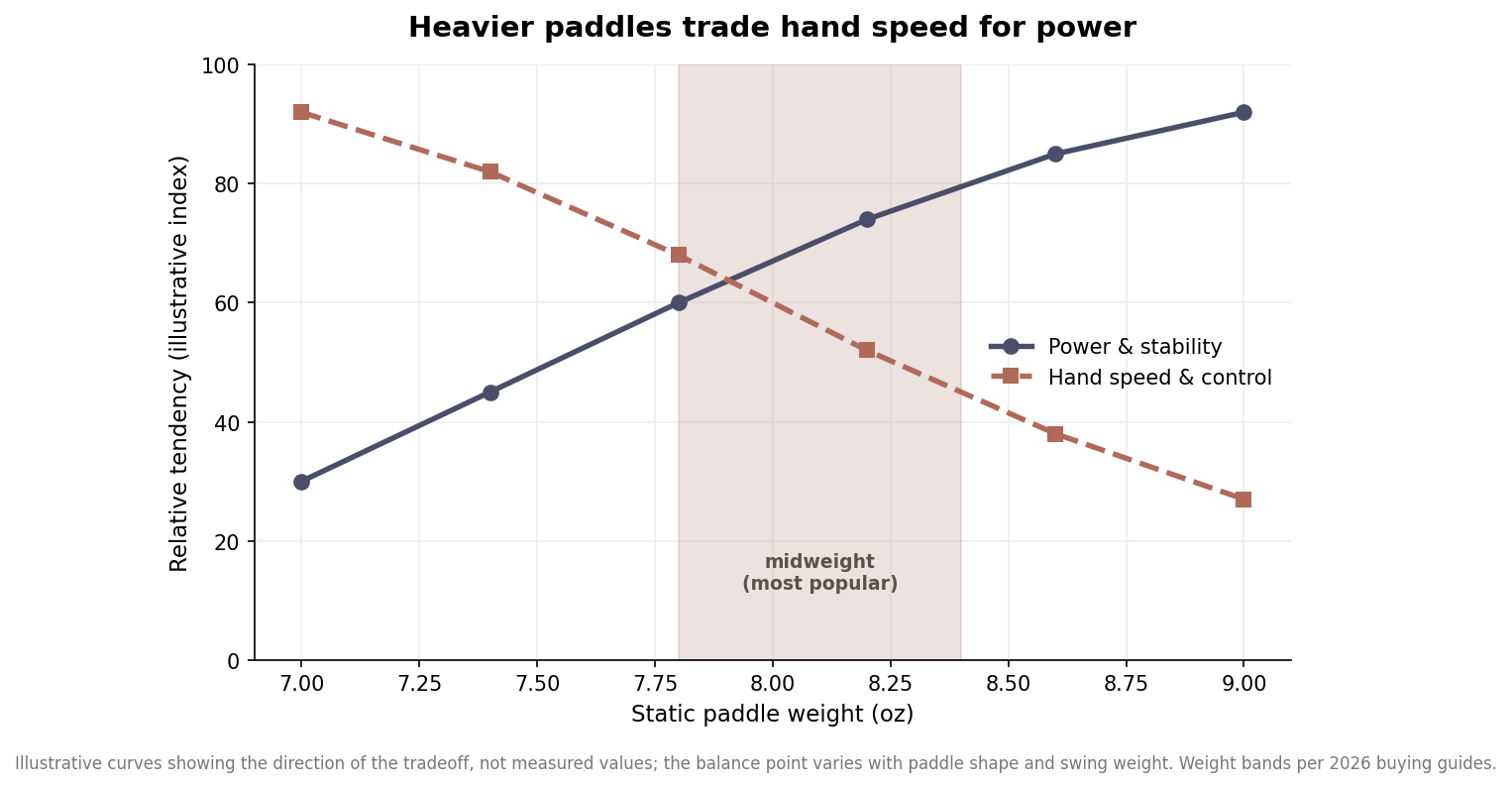
    Every ounce added to a paddle does two things at once, and they pull in opposite directions. More mass carries more energy into the ball, so a heavier paddle generates more pop on drives and resists twisting on off-center hits, which makes it more stable and more forgiving. The same mass is slower to move, so a heavier paddle costs you reaction time in fast hands battles at the kitchen line, where a lighter paddle lets you reset and counter a beat quicker.

    Line chart showing power and stability rising while hand speed and control fall as pickleball paddle weight increases from 7 to 9 ounces, with the midweight band highlighted
    As static weight rises, power and stability climb while hand speed and control drop; the midweight band is where the two curves cross.

    The curves above are drawn to show the direction of the tradeoff rather than measured values, because the exact balance point shifts with the paddle’s shape and how its weight is distributed. The takeaway is the crossing, not the precise numbers: somewhere in the midweight band, power and hand speed are both merely good rather than either being great, which is exactly why that band is the default. A lighter paddle asks you to supply the power yourself with faster swings, while a heavier one supplies it for you at the cost of quickness. Neither is better in the abstract; they are better for different players.

    Static weight versus swing weight

    The scale reading is only half the story. Static weight is what a paddle weighs sitting still; swing weight is how heavy it feels while you are moving it, and the two can diverge sharply. An elongated paddle carries more of its mass out toward the tip, so it can feel noticeably heavier through a swing than a standard-shape paddle of identical static weight. That is why a player can pick up two paddles that both read 8.0 ounces and swear one is heavier.

    This matters when you are choosing from a spec sheet rather than a demo rack. A number on paper does not capture feel, and if the paddle shape is elongated or the balance is head-heavy, the effective weight in play is higher than the static figure suggests. When you cannot swing before you buy, treat an elongated or head-heavy paddle as if it sits a step up the weight ladder from its printed ounces.

    Matching weight to how you play

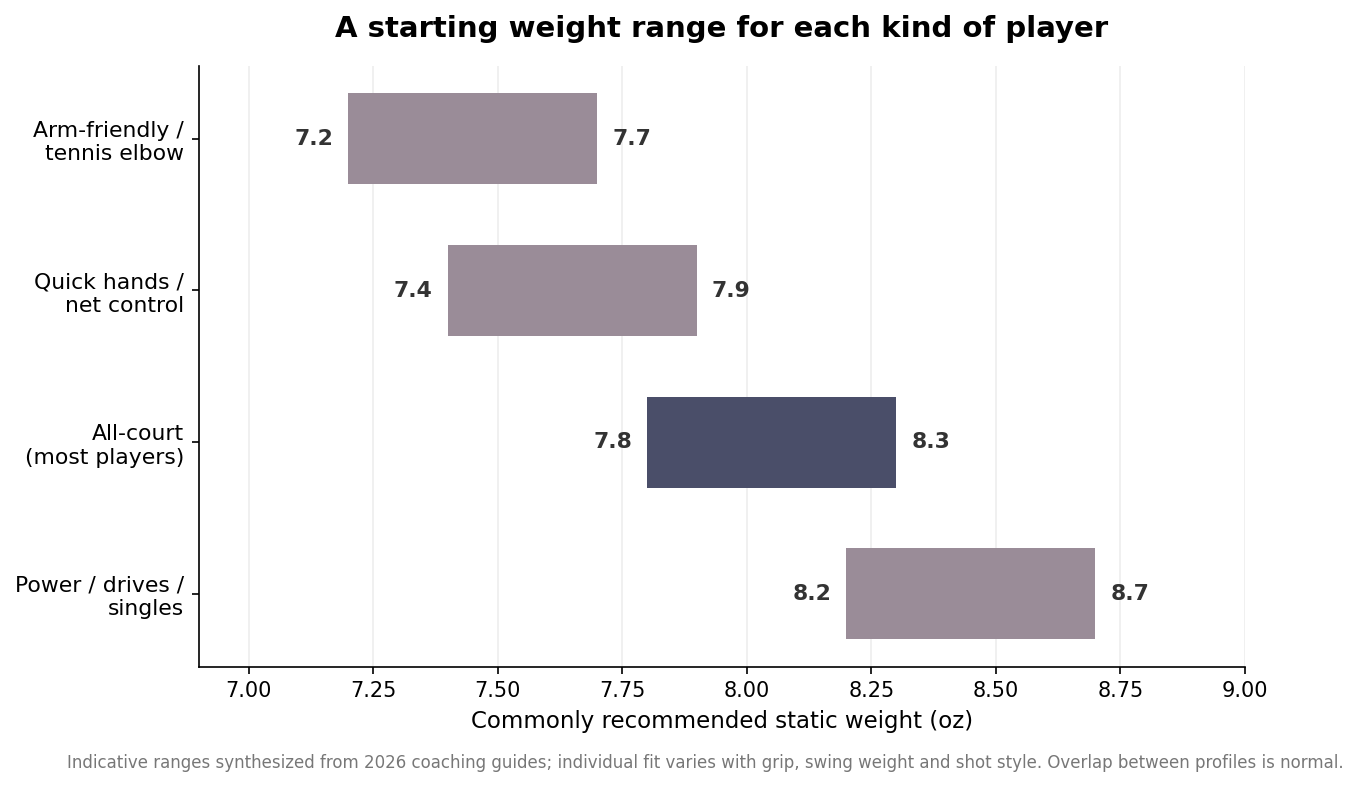
    The right weight follows from the game you actually play, not the game you admire. Players who live at the net and win with quick hands and soft resets tend to do well in the lighter part of the range, while players who win with drives, put-aways, and singles-style baseline power lean heavier for the extra pop and stability. Most recreational players are best served somewhere in the middle, which is both the safest starting point and the easiest to adjust from later.

    Range chart of commonly recommended pickleball paddle weight in ounces by player type, from arm-friendly 7.2-7.7 to power 8.2-8.7
    A commonly recommended starting weight range for each kind of player, with plenty of overlap between profiles.

    The arm question deserves its own line, because it is a real one. A heavier paddle sends more shock through the wrist and elbow on every contact, and dropping into a lighter paddle is one of the simplest ways to ease strain for a player prone to tennis elbow, a condition that affects an estimated one to three percent of adults in a given year. If a player is fighting elbow pain, the ranges above bias toward the lighter end regardless of style, and that is a trade worth making, since a comfortable paddle that stays in the bag less often beats a powerful one that hurts to use.

    Tuning weight on a custom paddle

    Weight is not fixed at the moment of purchase, which is good news for anyone speccing paddles for a group with mixed preferences. The common lever is lead tape applied around the edge of the face: place it near the top for a more head-heavy, higher-power feel, near the throat for a handle-heavy, quicker feel, or spread it around the rim to add overall mass and stability without shifting the balance much. A few grams changes the character of a paddle meaningfully, which lets a single base model flex toward several players.

    For a club or brand ordering in quantity, the practical move is to choose a base weight slightly below your target and let players add tape to taste, since it is far easier to add mass than remove it. Decide the static weight and the balance you want as deliberately as you decide the face material and the shape, and confirm both on the spec sheet before you order. Weight is the specification players notice first and complain about most, so getting it right up front is what keeps a batch of custom paddles in hands and out of the closet.

  • Pickleball Paddle Shapes: Elongated vs. Standard vs. Hybrid, and How to Choose

    Pickleball Paddle Shapes: Elongated vs. Standard vs. Hybrid, and How to Choose

    Two paddles can share the same core thickness, the same face material, and the same weight, and still play like different instruments because of their outline. Shape is the most visible difference between paddles and the least understood, and it decides where the sweet spot sits, how far you can reach, and how quickly you can flick a hand at the net. If you are choosing a paddle for yourself, outfitting a club, or specifying a custom run, understanding the three main shapes is the fastest way to match a paddle to how a person actually plays.

    The 24-inch box every shape is squeezed into

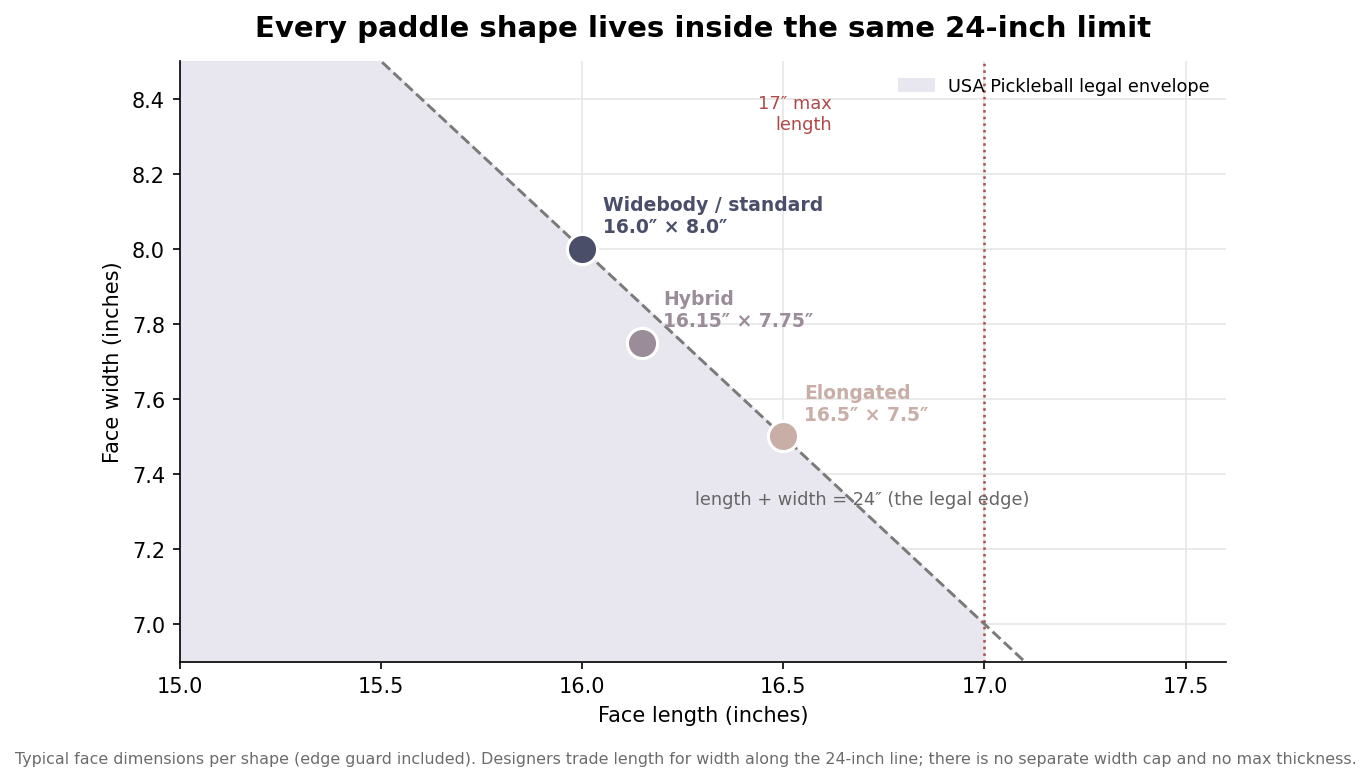
    Before comparing shapes it helps to know the rule that constrains all of them. Under USA Pickleball equipment standards, a paddle’s combined length and width, including the edge guard and end cap, cannot exceed 24 inches, and the length on its own cannot exceed 17 inches. There is no separate cap on width and, at present, no maximum thickness. That single combined-dimension rule is why paddles cannot simply be made bigger to help everyone: every extra half-inch of length has to be paid for with a narrower body. Designers are essentially sliding along one diagonal line, trading reach for width, and each named shape is just a different point on that line.

    Scatter plot of pickleball paddle face length versus width for widebody, hybrid and elongated shapes against the 24-inch legal limit
    Typical face dimensions for each shape sit along the same 24-inch length-plus-width limit; designers trade length for width.

    Seen this way, the shape debate is not about which paddle is larger. They are all within a hair of the same total size. It is about how a fixed budget of face is distributed: long and narrow, short and wide, or somewhere in between. Each distribution moves the sweet spot and changes the paddle’s balance, and those two effects are what a player actually feels.

    Widebody: the forgiving all-court default

    The widebody, often just called the standard shape, runs about 16 inches long and 8 inches wide. Putting more of the face budget into width does two useful things. It creates the largest and most centrally placed sweet spot of the three shapes, so off-center hits still come off cleanly, and it keeps mass closer to the hand, which makes the paddle feel quick and responsive in fast kitchen exchanges. This is the shape that most rewards players who spend their time at the non-volley line dinking, resetting, and trading quick volleys, and it is the most forgiving choice for beginners still building consistent contact.

    The trade-off is reach. A wider, shorter paddle covers less of the court on a stretch, and it generates a little less leverage on a swing. For a doubles player who lives at the net, neither cost bites often. For a singles player covering the whole court alone, both start to matter.

    Elongated: reach and leverage for the aggressive player

    An elongated paddle stretches to roughly 16.5 inches long while narrowing to about 7.5 inches wide. The extra length buys two things aggressive players want. It extends reach for wide balls and put-aways, which is especially valuable in singles, and the longer face acts as a longer lever, adding power and letting the tip travel faster for spin. The competitive singles field leans heavily toward elongated shapes for exactly these reasons.

    The cost of that reach is a smaller, higher sweet spot and slightly slower hands. Narrowing the body concentrates the responsive zone into a smaller area located higher up the face, so mishits are punished more, and pushing mass toward the tip makes the paddle a touch slower to maneuver in tight exchanges. Elongated paddles suit players with clean, repeatable contact who will trade forgiveness for reach and pop. They are a demanding choice for a beginner and a natural one for an experienced baseliner.

    Hybrid: the versatile middle

    Hybrid shapes sit deliberately between the two, commonly around 16 to 16.3 inches long and roughly 7.75 inches wide. The idea is to capture some of the elongated shape’s reach and leverage without giving up as much sweet spot or hand speed, and many hybrids taper the upper face to keep the paddle quick despite the added length. The result is a genuine all-rounder: not the most forgiving, not the longest, but comfortable across singles and doubles and across a range of skill levels. For a player who does not fit cleanly into net specialist or baseline aggressor, or for a club that wants one shape that works for many hands, the hybrid is often the safest specification.

    Matching shape to how someone actually plays

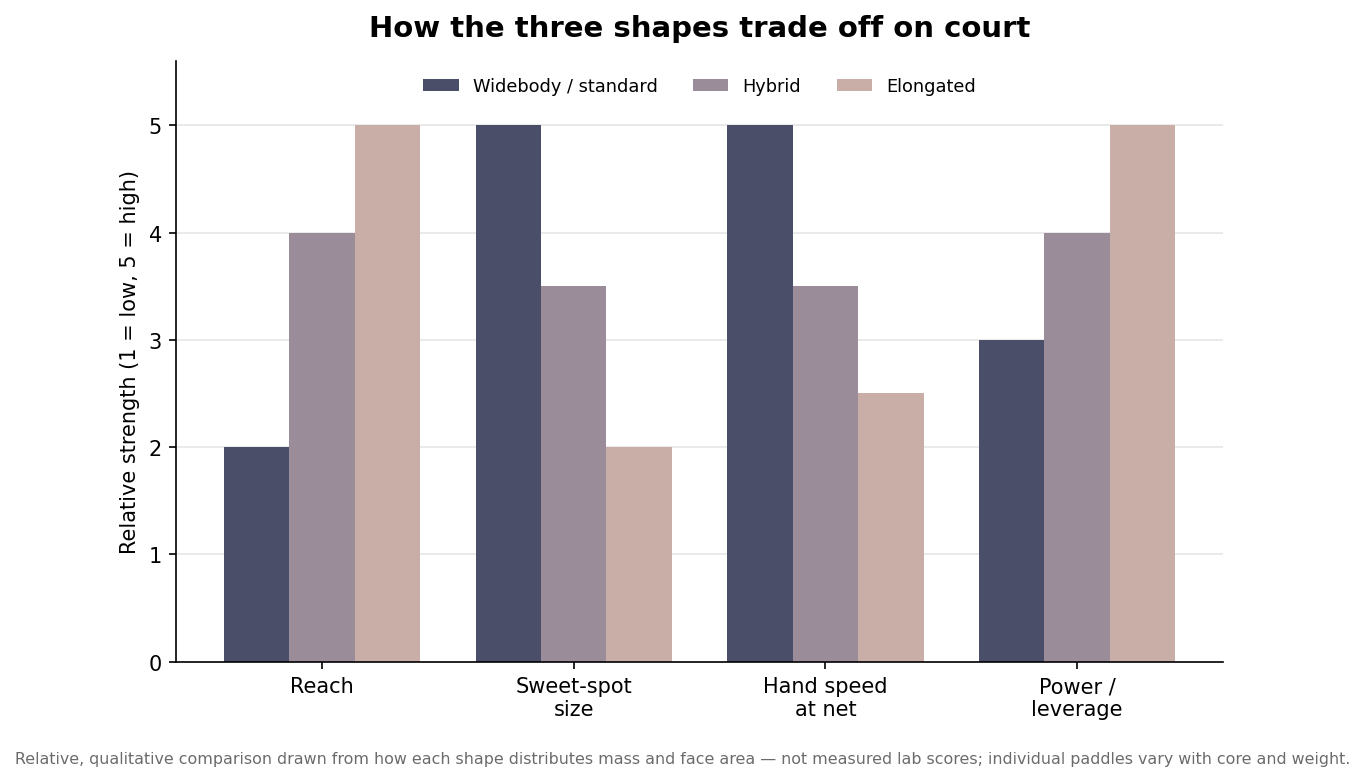
    The honest way to choose is to start from playing style rather than from a spec sheet. A player who wins points at the kitchen with quick hands and soft resets is best served by a widebody, whose large sweet spot and net-ready balance reward that game. A player who attacks from the back, plays singles, or wants maximum reach and power should look at an elongated shape and accept the smaller margin for error. A player who does a bit of everything, or who is still discovering their style, is usually happiest on a hybrid. The chart below summarizes those trade-offs across the attributes players notice most.

    Grouped bar chart comparing reach, sweet-spot size, hand speed and power across widebody, hybrid and elongated paddle shapes
    A relative comparison of how each shape trades reach and power against sweet-spot size and hand speed at the net.

    These ratings are relative rather than measured, and real paddles complicate them: core thickness, total weight, and where that weight sits will shift how any shape plays, and two elongated paddles can feel different from each other. Treat shape as the first filter that gets you into the right neighborhood, then let thickness, weight, and face material fine-tune the feel. For a custom order in particular, decide the shape around the intended player or the typical member of a club before anything else, because it is the one variable that is fixed the moment the mold is chosen and the hardest to change your mind about later.

  • Pickleball Paddle Thickness: 14mm vs 16mm Cores and How to Choose

    Pickleball Paddle Thickness: 14mm vs 16mm Cores and How to Choose

    Face material gets most of the attention when people shop for a pickleball paddle, but the specification that changes how a paddle actually plays is buried inside it: the core thickness, measured in millimeters. Two paddles with identical carbon faces and identical shapes can feel like completely different instruments if one has a 14mm core and the other a 16mm core. If you are outfitting a club, a brand, or an event and need to pick a spec that suits your players, thickness is the number to get right first. This is a straight comparison of what those millimeters do and how to choose.

    What core thickness actually measures

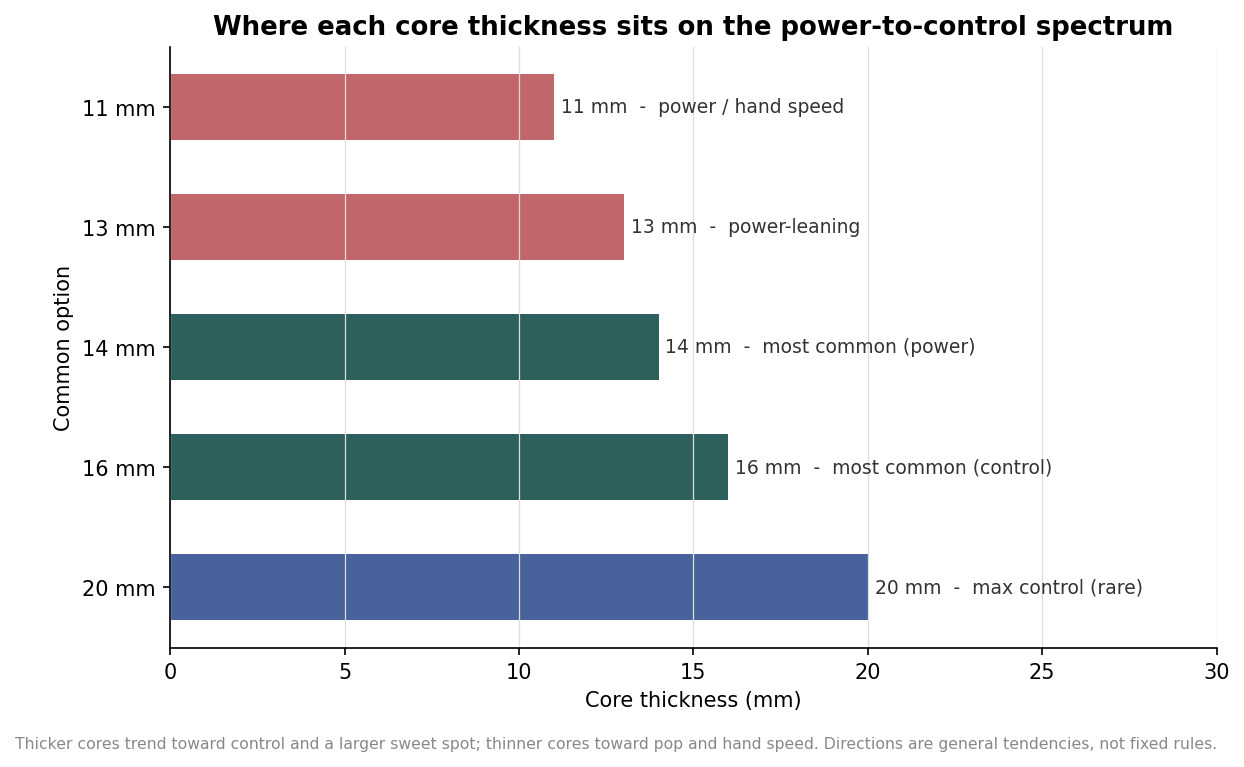
    Nearly every modern paddle is built around a polypropylene honeycomb core sandwiched between two face sheets. Core thickness is the depth of that honeycomb, and it typically runs from about 11mm at the thin, punchy end to 20mm at the thick, cushioned end. The two options that dominate the market are 14mm and 16mm, with 13mm common on power-oriented models. The chart below places the usual options on the spectrum that runs from power at the thin end to control at the thick end. The thickness is a real, measurable dimension; the power-versus-control direction is a general tendency, not a guarantee, because face material and paddle shape also pull on the same levers.

    Horizontal bar chart of common pickleball paddle core thickness options from 11mm to 20mm on the power-to-control spectrum
    Common core thicknesses, with 14mm and 16mm dominating the market; thinner leans power, thicker leans control.

    The reason thickness matters so much comes down to how the core deforms on contact. A thinner core compresses less and springs the ball back faster, which reads as pop. A thicker core flexes and absorbs more of the impact, which reads as a soft, controlled touch and a more forgiving response on off-center hits.

    14mm: the power and hand-speed end

    A 14mm core is the default choice for players who win points at the net with speed. It delivers more pop and a snappier, more connected feel, and because there is less material in the core, a 14mm paddle usually comes in a touch lighter and moves faster through quick hand battles. That responsiveness has a cost. The thinner core transmits more vibration to the hand, the sweet spot tends to feel smaller and less forgiving, and mishits are punished more obviously. Aggressive players and those with sound mechanics often accept that trade for the extra put-away power and reaction speed, and it is a common pick for singles play where driving the ball matters more than extended soft exchanges.

    16mm: the control and touch end

    Step up to 16mm and the paddle changes character. The thicker core absorbs more energy, softening the feel and expanding the effective sweet spot, which makes dinks, resets, and third-shot drops land more predictably. It also dampens vibration, which many players with arm or elbow sensitivity find easier on the joints over a long session. The trade is that a 16mm paddle gives up some raw pop and usually weighs a little more, so you work slightly harder to generate pace on drives. For doubles players who live at the kitchen line and value placement and consistency over power, 16mm is the more forgiving foundation, and it is generally the easier spec to recommend to a mixed-ability group.

    Weight and the legal envelope ride along with thickness

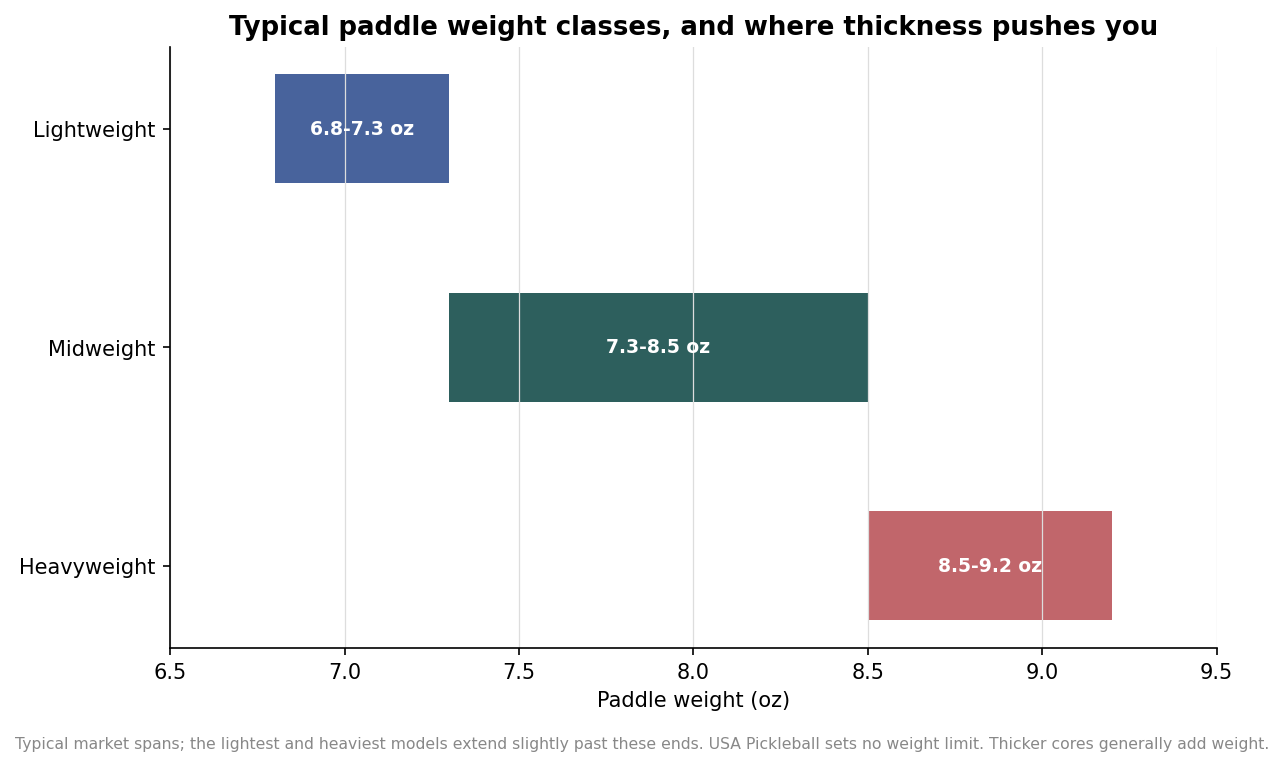
    Thickness does not move in isolation. Adding core depth generally adds a little weight, so a 16mm model tends to sit higher in the weight range than its 14mm sibling. Most paddles fall between about 7.3 and 8.5 ounces, the midweight band that balances power and control, with lightweight models coming in under roughly 7.3 ounces and heavier paddles pushing past 8.5. The chart below shows the typical spans; treat the ends as soft, since a handful of models sit slightly outside them. USA Pickleball sets no weight limit at all, so weight is purely a feel-and-fatigue decision rather than a compliance one.

    Range bar chart of typical pickleball paddle weight classes in ounces: lightweight, midweight, and heavyweight
    Typical paddle weight spans in ounces; thicker cores tend to sit toward the heavier end.

    Where the rules do bite is on dimensions. A paddle’s length cannot exceed 17 inches, and the combined length plus width, including the edge guard and end cap, cannot exceed 24 inches. There is no official cap on core thickness, which is why 16mm and even thicker cores are legal for sanctioned play. If your paddles will be used in USA Pickleball events, confirm each model appears on the approved equipment list, since approval also depends on surface roughness and other factors the equipment standards test for.

    Choosing a thickness for a group order

    When you are buying for other people rather than yourself, resist the urge to chase the most aggressive spec. A 16mm core is the safer default for a broad or beginner-heavy group because the larger sweet spot and softer feel flatter a wider range of skill levels and are gentler on arms. Reserve 14mm for programs aimed at competitive or power players who have specifically asked for pop and speed. If your order is large enough to justify two versions, offering a 16mm control model and a 14mm power model covers most preferences without fragmenting your inventory. Pair the thickness decision with grip circumference, which commonly runs from 4 inches up to 4 and three-quarter inches, since a grip that is too large is harder to correct than a thickness that leans one way or the other. Whatever you choose, order a sample and let a couple of real players hit with it before committing a full run, because thickness is felt in the hand long before it shows up in a spec sheet.

  • A Pro Shop’s Guide to Custom Pickleball Paddle Margins | Custom Paddles Co

    Call or Text us: (929) 605-4397

    HomeBlog › Pro Shop Paddle Margins

    Retail

    A Pro Shop’s Guide to Custom Pickleball Paddle Margins

    06/15/2026

    A branded paddle is one of the highest-margin items a pro shop or club can put on its shelf — and unlike a national brand, it is a product only you can sell. Because you control the design and the wholesale cost, you also control the markup. The trick is pricing it so it moves at volume while still funding your programming.

    Here is how to think about tiers, bundling, and positioning so your custom paddle line actually pads the bottom line.

    Start with your landed cost

    Custom paddles are quoted per order, with per-unit cost depending on the model and quantity — a Rec & Starter Paddle at the low end, a Carbon Fiber Tournament Paddle at the top. Since per-unit cost drops as the run grows, your first job is to order at a tier that lands your cost where a healthy markup still leaves a shelf price your members will happily pay.

    Use volume tiers to your advantage

    Bigger orders lower your cost per paddle, which either widens your margin or lets you undercut the sporting-goods store down the road while keeping the same margin. A club that commits to a 100-paddle run can price aggressively for members and still clear a strong profit. Order to a tier, not to the exact number you think you will sell this month.

    TierRelative costShelf positioningMargin
    Rec & Starter (100+)ValueEntry58%
    Fiberglass Club (50+)MidMid54%
    Graphite Pro (50+)PremiumPremium51%
    Carbon Tournament (25+)Highest tierTop shelf50%

    *Illustrative numbers only — request a quote for pricing at your quantity.

    Bundle to raise the average ticket

    The fastest way to lift your average sale is a Branded Paddle Gift Set — a paddle paired with matching accessories at a package price. Bundles feel like a value to the buyer while carrying more total margin than a paddle alone, and they make an easy holiday or new-member gift that members buy without much deliberation.

    Position branded against the national brands

    You will not out-market a major label on brand name, so do not try. Sell what they cannot: a paddle with your club logo, in your colors, that members wear as identity. Price it in the same neighborhood as a comparable national paddle — buyers who value belonging will choose yours, and the exclusivity justifies a full-margin price. If you want to reassure skeptics, point them to why custom paddles play just as well as the big brands.

    Key takeawayOrder at a volume tier to lower your landed cost, price custom paddles at 50–58% margin, and bundle into gift sets — then sell the one thing national brands cannot: your logo.

    Want wholesale pricing for your shop or club? Get a custom quote at your volume — free mockups in 24 hours, with a lowest-price guarantee. Learn more about how we work, or browse more guides.

    More posts

  • How to Order Custom Pickleball Paddles: A Step-by-Step Checklist | Custom Paddles Co

    Call or Text us: (929) 605-4397

    HomeBlog › How to Order Custom Paddles

    Ordering

    How to Order Custom Pickleball Paddles: A Step-by-Step Checklist

    05/26/2026

    Ordering custom paddles for the first time sounds more complicated than it is. If you have the right pieces ready before you reach out, the whole process is smooth — pick a model, send artwork, approve a mockup, and wait for the boxes to land. This checklist walks through each step in order so nothing slows you down.

    Step 1: Pick your paddle model

    Start with the feel your players want. Choose the Graphite Pro Paddle or Carbon Fiber Tournament Paddle for control and spin, the Fiberglass Club Paddle for lively all-around play, or the Rec & Starter Paddle for beginners and giveaways. If you are buying a gift, the Branded Paddle Gift Set pairs a paddle with matching accessories. Not sure? We will recommend a model based on your group — and our graphite vs. fiberglass guide is a good primer.

    Step 2: Gather your artwork

    The best artwork is a vector file — an .ai, .eps, .pdf, or .svg — because it scales to the full paddle face without going blurry. A high-resolution PNG with a transparent background works too. Note your exact colors (Pantone or hex) if brand consistency matters. If all you have is a rough idea or a low-res logo, send it anyway; we can often clean it up or recreate it as part of the mockup.

    Step 3: Choose your quantity

    Our minimum order is just 12 paddles, and per-unit pricing improves as the run grows, so it pays to confirm your headcount before ordering. Remember you can mix models within a single order to cover different skill levels or budgets. If the paddles are for a dated event, order to your cap plus a small buffer for latecomers.

    Step 4: Approve your free mockup

    Once we have your model, artwork, and quantity, we send a free digital mockup within 24 hours showing your design on the actual paddle. Review the logo placement, colors, and any names or numbers, then request changes — revisions are unlimited and free, so keep refining until it is exactly right. Nothing goes to production until you approve.

    Step 5: Production and shipping

    After you sign off, production runs 2 weeks (faster turnaround available with express shipping), and we ship nationwide. We will confirm your timeline against any deadline up front, so if you have an event date, tell us early. When your paddles arrive, they are ready to hand out or stock — no assembly needed.

    Step 6: Reorders are easy

    We keep your approved artwork and specs on file, so a reorder for new members or next season’s event skips straight to production. Just tell us how many, and we pick up where you left off.

    Key takeawayHave your model, vector artwork, and quantity ready, approve the free 24 hour mockup, and plan for 2 weeks (faster turnaround available with express shipping) of production — then reorders on file are a one-message job.

    Ready to start? Get a custom quote and we will send a free mockup in 24 hours. Learn more about how we work, or browse more guides.

    More posts

  • Do Custom Pickleball Paddles Actually Play Well? A Performance & Durability Breakdown | Custom Paddles Co

    Call or Text us: (929) 605-4397

    HomeBlog › Do Custom Paddles Play Well?

    Buyer guides

    Do Custom Pickleball Paddles Actually Play Well? A Performance & Durability Breakdown

    05/08/2026

    There is a stubborn myth that a custom-printed paddle is somehow a downgrade — that a logo on the face means you are trading performance for looks. It is worth putting to rest, because it is simply not how these paddles are made. The design is dye-sublimated into the face, not stuck on top of it, so it has no bearing on how the paddle plays.

    Here is what actually determines performance, and how a well-built custom paddle holds up over a season of hard play.

    The print is in the face, not on it

    Dye-sublimation turns the ink into a gas that bonds into the surface of the face material. There is no raised layer, no sticker, and no added thickness — the graphite or fiberglass face plays exactly as it would blank. You cannot feel the design under the ball, and it will not peel, because there is nothing sitting on the surface to peel.

    What really drives performance: core and face

    Two things decide how a paddle plays: the polypropylene honeycomb core and the face material bonded to it. The core sets the overall feel and dwell time; the face sets control versus power. A printed Graphite Pro plays like an unprinted Graphite Pro, and a Fiberglass Club plays with the same pop whether it is blank or covered in your club colors. If you want to go deeper on face choice, our guide to graphite vs. fiberglass faces breaks it down.

    ConcernReality
    “The printed design slows the ball down”Dye-sublimation adds no thickness or weight; the face responds identically to a blank one.
    “Custom paddles use cheaper cores”Ours use the same polypropylene honeycomb cores and graphite, carbon, or fiberglass faces as name brands.
    “The graphic will peel or scratch off”The color is bonded into the face, so there is no surface layer to peel; it fades far slower than paint or stickers.
    “They won’t survive tournament play”A protective edge guard and honeycomb core give the same impact resistance as any competitive paddle.

    Durability where it counts

    Longevity in a paddle comes down to three things: the edge guard that absorbs mishits and net scrapes, the honeycomb core that resists denting, and the bond between face and core. Our paddles use a protective edge guard and a quality polypropylene honeycomb, so they take the same knocks a competitive player expects to dish out over a season.

    Print longevity in the real world

    Because the color is part of the face rather than a coating, it holds up to sweat, sun, and repeated wipe-downs far better than a painted logo or a heat-pressed patch ever could. Players regularly report that the design still looks sharp long after a comparable sticker would have started lifting at the edges.

    Key takeawayA dye-sublimated design adds no thickness and no weight — performance is set by the core and face, and a custom paddle plays and lasts exactly like its blank equivalent.

    Want a paddle that looks custom and plays like a pro’s? Get a custom quote — free mockups in 24–48 hours. Learn more about how we work, or browse more guides.

    More posts

  • Custom Pickleball Paddles for Tournaments & Events: A Buyer’s Guide | Custom Paddles Co

    Call or Text us: (929) 605-4397

    HomeBlog › Paddles for Tournaments & Events

    Tournaments

    Custom Pickleball Paddles for Tournaments & Events: A Buyer’s Guide

    04/19/2026

    A custom paddle is one of the few pieces of event swag people actually keep and use. Long after the medals are put away, players are still hitting with the paddle from your tournament — carrying your event name and your sponsors’ logos to every court they visit. That staying power is exactly why paddles make such strong player gifts, sponsor activations, and prizes.

    Here is how to plan a paddle order around a fixed event date so it arrives on time, covers your headcount, and gives sponsors real value.

    Three ways paddles earn their keep at events

    The first is player swag: a branded paddle in every registration bag makes participants feel the entry fee was worth it and turns them into ongoing advertisers for next year. The second is sponsor activation — a full-color paddle gives a title sponsor far more visible real estate than a banner or a koozie. The third is prizes: a small run of premium Carbon Fiber Tournament Paddles makes a memorable award for bracket winners.

    Planning lead time around your event date

    The single most important number is your event date, and you should work backward from it. Budget 24 hours for us to return a mockup, a few days for revisions and approval, then 2 weeks (faster turnaround available with express shipping) of production, plus shipping transit. That puts your safe order window at about three to four weeks before the event — earlier if you are ordering several hundred paddles or coordinating multiple sponsor logos.

    Getting your quantities right

    Order to your registration cap, not your current sign-ups, and add a buffer. Late registrations, walk-ups, volunteers, staff, and a few keepsakes for organizers add up fast, so a 10–15% cushion on top of your expected headcount is smart. Our minimum is just 12 paddles, and larger runs earn better per-unit pricing, so slightly over-ordering often costs less per paddle than a panic reorder later.

    Co-branding with sponsors

    Because our paddles print edge-to-edge in full color, you can place your event logo on the upper face and reserve a clean sponsor panel lower down — or give a title sponsor the whole back face. Collect sponsor artwork as vector files early; chasing a low-resolution logo the week before your deadline is the most common cause of delay. We will lay everything out in the mockup so sponsors can approve their placement before production.

    When the calendar is tight: rush options

    If your event is closer than the standard window, tell us the hard date up front. We can often prioritize the mockup and compress production for time-sensitive events — the earlier you flag the deadline, the more options we have. A firm date and print-ready artwork are what make a rush possible.

    Key takeawayWork backward from your event date with a three-to-four-week window, order to your registration cap plus a 10–15% buffer, and collect sponsor artwork as vector files early.

    Planning paddles for an upcoming event? Get a custom quote with your date and headcount — free mockups in 24 hours. Learn more about how we work, or browse more guides.

    More posts

  • Graphite vs. Fiberglass Pickleball Paddles: Which Face Should You Choose | Custom Paddles Co

    Call or Text us: (929) 605-4397

    HomeBlog › Graphite vs. Fiberglass Paddles

    Buyer guides

    Graphite vs. Fiberglass Pickleball Paddles: Which Face Should You Choose

    04/01/2026

    Every custom paddle starts with a decision most buyers skip past: what the hitting face is made of. Graphite and fiberglass are the two most common choices, and they play very differently. The core does a lot of the work, but the face is what your hand feels on contact — and for a bulk club or event order, picking the right one keeps your members happy on day one.

    Here is a plain-English breakdown of how each face plays, where the newer carbon options fit, and how to choose for a group order.

    How the face material changes your game

    The face is the thin outer layer bonded to the paddle’s polypropylene honeycomb core. A stiffer, smoother face like graphite transfers energy quickly and gives a crisp, connected feel, which players read as control and touch. A slightly more flexible face like fiberglass flexes on impact and springs back, adding power and pop. Neither is objectively better — they suit different styles.

    Graphite: control and touch

    Graphite (carbon) faces are the choice for players who win with placement, dinks, and soft resets at the kitchen line. The stiff surface gives a predictable, low-vibration response so you always know where the ball is going. Our Graphite Pro Paddle is built around this feel, and the Carbon Fiber Tournament Paddle takes it further with a textured raw-carbon option for players chasing extra spin.

    Fiberglass: power and pop

    Fiberglass faces flex more, which launches the ball with noticeably more pace off the same swing. Rec players love it because it makes drives and serves feel effortless, and it is the most forgiving choice for newcomers. Our Fiberglass Club Paddle is the workhorse here — approachable enough for a first-timer, lively enough to keep an intermediate engaged.

    FaceFeelBest forOur model
    GraphiteCrisp, controlled, low vibrationPlacement, dinks, soft gameGraphite Pro Paddle
    Raw carbonGrippy, high spinCompetitive spin playersCarbon Fiber Tournament Paddle
    FiberglassLively, powerful, forgivingPower, drives, rec playFiberglass Club Paddle
    Fiberglass (entry)Easy, big sweet spotBeginners and starter kitsRec & Starter Paddle

    A note on carbon and thermoformed faces

    You will hear a lot about raw carbon fiber and thermoformed construction. Raw carbon leaves the face texture exposed for a grippier surface that generates more spin, and thermoforming wraps the edges for a stiffer, more responsive body. Both live on the higher-performance end of the spectrum — great for competitive rosters, though not necessary for a casual league.

    How to choose for a bulk order

    For a mixed group, match the face to the majority of your players. Rec-heavy leagues do best on fiberglass; competitive clubs lean graphite or raw carbon. And remember you do not have to pick just one — because our minimum is just 12 paddles and you can mix models in a single order, many buyers split the run so beginners get fiberglass pop while their travel team gets graphite control.

    Key takeawayChoose graphite for control and touch, fiberglass for power and forgiveness — and for a group order, mix models so each skill level gets the face that suits it.

    Not sure which face fits your group? Get a custom quote and we will recommend a model — free mockups in 24 hours. Learn more about how we work, or browse more guides.

    More posts

  • Custom Pickleball Paddles for Clubs & Leagues: A Personalization Guide | Custom Paddles Co

    Call or Text us: (929) 605-4397

    HomeBlog › Custom Paddles for Clubs & Leagues

    Clubs

    Custom Pickleball Paddles for Clubs & Leagues: A Personalization Guide

    03/15/2026

    A branded paddle is the most visible thing a pickleball club owns. It shows up on every court, in every group photo, and in every social post your members share — which is exactly why more clubs and leagues are printing their logo edge-to-edge instead of handing out generic gear. Done well, a custom paddle turns members into walking advertisements and gives your pro shop a product no national brand can match.

    Here is how to plan a club or league paddle program that reinforces your identity, opens a new revenue line, and keeps every skill tier happy.

    Why clubs and leagues brand their paddles

    The obvious reason is identity: a full-color, dye-sublimated club logo makes your membership instantly recognizable at open play, ladder nights, and travel tournaments. But the business case runs deeper. A branded paddle is a member perk that feels premium, a pro-shop SKU you can sell at a healthy margin, and a canvas for sponsor logos that helps fund your programming.

    Because our paddles print full color across the entire face, you can combine your club mark, your court or facility name, and a sponsor panel on a single paddle without it looking crowded — something you simply cannot do with a logo sticker or a heat-pressed patch.

    Planning quantities across skill tiers

    Most clubs serve a mix of rec players, intermediates, and competitive members, and those groups want different paddles. A smart order splits the run across a few models rather than forcing everyone onto one. New and social members are happy with a Rec & Starter Paddle, ladder players tend to want the Fiberglass Club Paddle or Graphite Pro, and your travel team will ask for the Carbon Fiber Tournament Paddle.

    Our minimum is just 12 paddles, and you can mix models within an order, so a single purchase order can outfit three tiers at once. Estimate each tier from your current roster, then add a small buffer for new members and pro-shop stock.

    Personalization options that work

    Beyond the club logo, the most requested touches are member names or nicknames along the throat, court or team numbers for league play, and a dedicated sponsor panel near the paddle’s edge. Because everything is printed rather than applied, adding a name costs nothing in durability — it is part of the same dye-sublimated face. For leagues, numbered paddles double as a roster and make lost-and-found on a busy court trivial.

    Choosing a model for a mixed roster

    If you want one model for the whole club, the Fiberglass Club Paddle is the safest default: it has the forgiving pop that keeps recreational players engaged while still holding up for competitive play. If your membership skews serious, anchor the order on the Graphite Pro or Carbon Fiber Tournament Paddle and offer the Rec & Starter as an entry option. We are happy to send a mockup of your logo on two or three faces so your board can compare before you commit.

    Key takeawaySplit your club order across two or three paddle models so every skill tier gets the right feel, and use the printable face for member names, court numbers, and sponsor logos all at once.

    Ready to outfit your club or league? Get a custom quote — free mockups in 24 hours, with unlimited revisions until it looks right. Learn more about how we work, or browse more guides.

    More posts