Two paddles can share the same core thickness, the same face material, and the same weight, and still play like different instruments because of their outline. Shape is the most visible difference between paddles and the least understood, and it decides where the sweet spot sits, how far you can reach, and how quickly you can flick a hand at the net. If you are choosing a paddle for yourself, outfitting a club, or specifying a custom run, understanding the three main shapes is the fastest way to match a paddle to how a person actually plays.
The 24-inch box every shape is squeezed into
Before comparing shapes it helps to know the rule that constrains all of them. Under USA Pickleball equipment standards, a paddle’s combined length and width, including the edge guard and end cap, cannot exceed 24 inches, and the length on its own cannot exceed 17 inches. There is no separate cap on width and, at present, no maximum thickness. That single combined-dimension rule is why paddles cannot simply be made bigger to help everyone: every extra half-inch of length has to be paid for with a narrower body. Designers are essentially sliding along one diagonal line, trading reach for width, and each named shape is just a different point on that line.
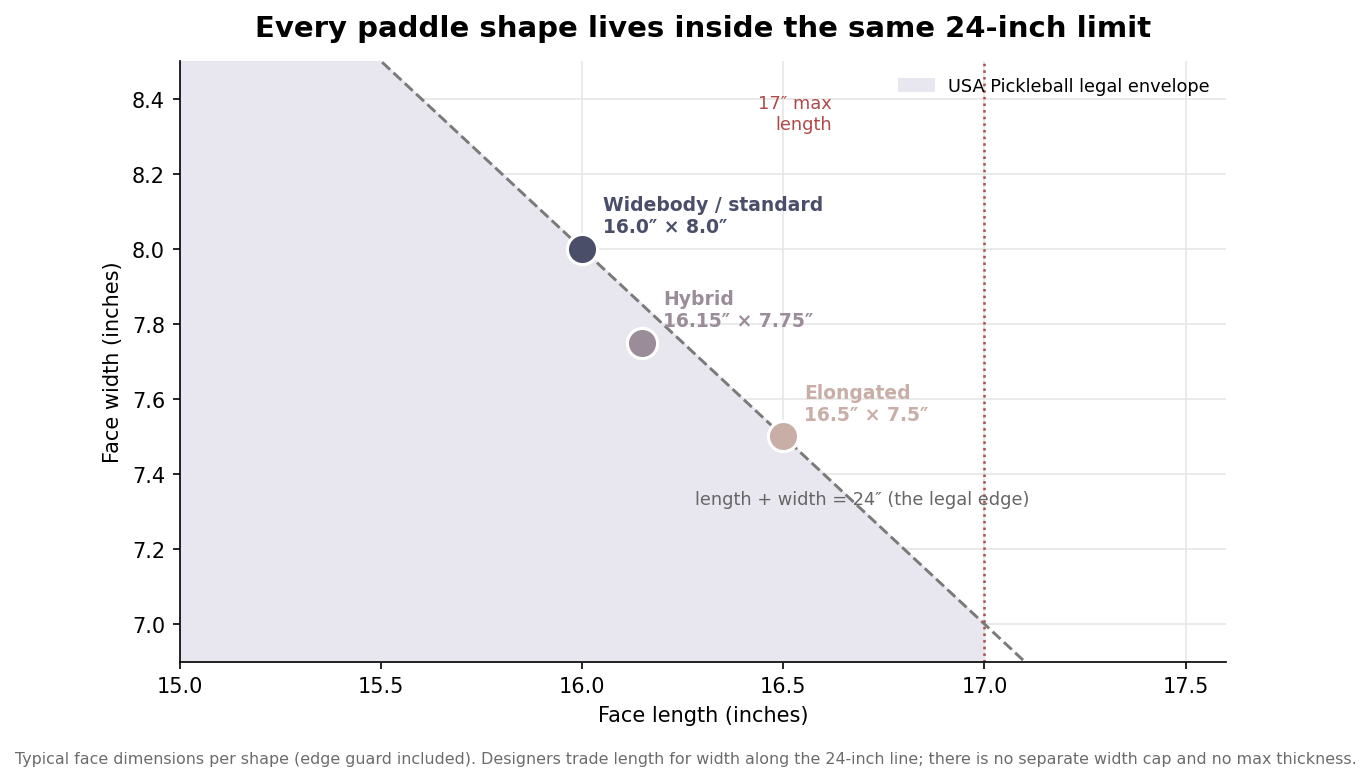
Seen this way, the shape debate is not about which paddle is larger. They are all within a hair of the same total size. It is about how a fixed budget of face is distributed: long and narrow, short and wide, or somewhere in between. Each distribution moves the sweet spot and changes the paddle’s balance, and those two effects are what a player actually feels.
Widebody: the forgiving all-court default
The widebody, often just called the standard shape, runs about 16 inches long and 8 inches wide. Putting more of the face budget into width does two useful things. It creates the largest and most centrally placed sweet spot of the three shapes, so off-center hits still come off cleanly, and it keeps mass closer to the hand, which makes the paddle feel quick and responsive in fast kitchen exchanges. This is the shape that most rewards players who spend their time at the non-volley line dinking, resetting, and trading quick volleys, and it is the most forgiving choice for beginners still building consistent contact.
The trade-off is reach. A wider, shorter paddle covers less of the court on a stretch, and it generates a little less leverage on a swing. For a doubles player who lives at the net, neither cost bites often. For a singles player covering the whole court alone, both start to matter.
Elongated: reach and leverage for the aggressive player
An elongated paddle stretches to roughly 16.5 inches long while narrowing to about 7.5 inches wide. The extra length buys two things aggressive players want. It extends reach for wide balls and put-aways, which is especially valuable in singles, and the longer face acts as a longer lever, adding power and letting the tip travel faster for spin. The competitive singles field leans heavily toward elongated shapes for exactly these reasons.
The cost of that reach is a smaller, higher sweet spot and slightly slower hands. Narrowing the body concentrates the responsive zone into a smaller area located higher up the face, so mishits are punished more, and pushing mass toward the tip makes the paddle a touch slower to maneuver in tight exchanges. Elongated paddles suit players with clean, repeatable contact who will trade forgiveness for reach and pop. They are a demanding choice for a beginner and a natural one for an experienced baseliner.
Hybrid: the versatile middle
Hybrid shapes sit deliberately between the two, commonly around 16 to 16.3 inches long and roughly 7.75 inches wide. The idea is to capture some of the elongated shape’s reach and leverage without giving up as much sweet spot or hand speed, and many hybrids taper the upper face to keep the paddle quick despite the added length. The result is a genuine all-rounder: not the most forgiving, not the longest, but comfortable across singles and doubles and across a range of skill levels. For a player who does not fit cleanly into net specialist or baseline aggressor, or for a club that wants one shape that works for many hands, the hybrid is often the safest specification.
Matching shape to how someone actually plays
The honest way to choose is to start from playing style rather than from a spec sheet. A player who wins points at the kitchen with quick hands and soft resets is best served by a widebody, whose large sweet spot and net-ready balance reward that game. A player who attacks from the back, plays singles, or wants maximum reach and power should look at an elongated shape and accept the smaller margin for error. A player who does a bit of everything, or who is still discovering their style, is usually happiest on a hybrid. The chart below summarizes those trade-offs across the attributes players notice most.
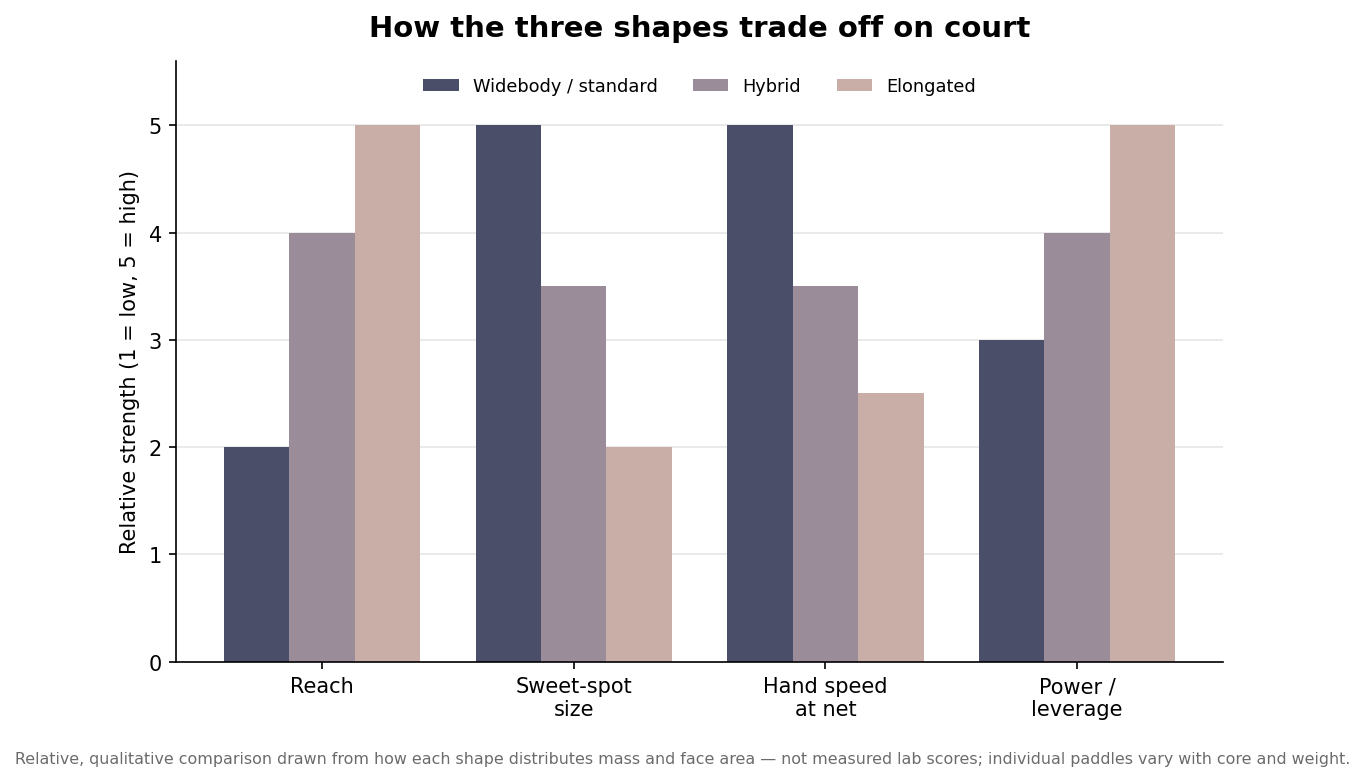
These ratings are relative rather than measured, and real paddles complicate them: core thickness, total weight, and where that weight sits will shift how any shape plays, and two elongated paddles can feel different from each other. Treat shape as the first filter that gets you into the right neighborhood, then let thickness, weight, and face material fine-tune the feel. For a custom order in particular, decide the shape around the intended player or the typical member of a club before anything else, because it is the one variable that is fixed the moment the mold is chosen and the hardest to change your mind about later.
Leave a Reply