Ask two pickleball players what makes a paddle good and one will say power while the other says control, and both are really talking about weight. It is the single specification that touches everything else: how hard you can drive a ball, how fast your hands are at the net, how stable the paddle stays on a mishit, and how your elbow feels after three games. Face material and shape matter, but weight is the one you feel on the very first swing, and it is the easiest to get wrong when ordering paddles you have not held.
This is a head-to-head look at how light, mid, and heavy paddles actually play, so you can put a number on the tradeoff before you commit, whether you are buying one paddle or speccing a batch for a club.
The three weight classes, and where most paddles sit
Paddle weight is measured in ounces, and while the exact cutoffs vary from one guide to the next, the working bands are consistent enough to use. Lightweight paddles come in under about 7.8 ounces, midweight paddles fall roughly between 7.8 and 8.4 ounces, and heavyweight paddles run above 8.4. The center of gravity for the whole market sits in the midweight band, and the single most common spec is a midweight around 8.0 ounces, which is where most players and most stock paddles land for a reason.
Treat those numbers as bands, not walls. One brand’s 7.8-ounce paddle can feel livelier than another’s because the mass is distributed differently, which is why two paddles on the same scale reading can play nothing alike. The class tells you the neighborhood; it does not tell you the exact address.
What weight buys you, and what it costs
Every ounce added to a paddle does two things at once, and they pull in opposite directions. More mass carries more energy into the ball, so a heavier paddle generates more pop on drives and resists twisting on off-center hits, which makes it more stable and more forgiving. The same mass is slower to move, so a heavier paddle costs you reaction time in fast hands battles at the kitchen line, where a lighter paddle lets you reset and counter a beat quicker.
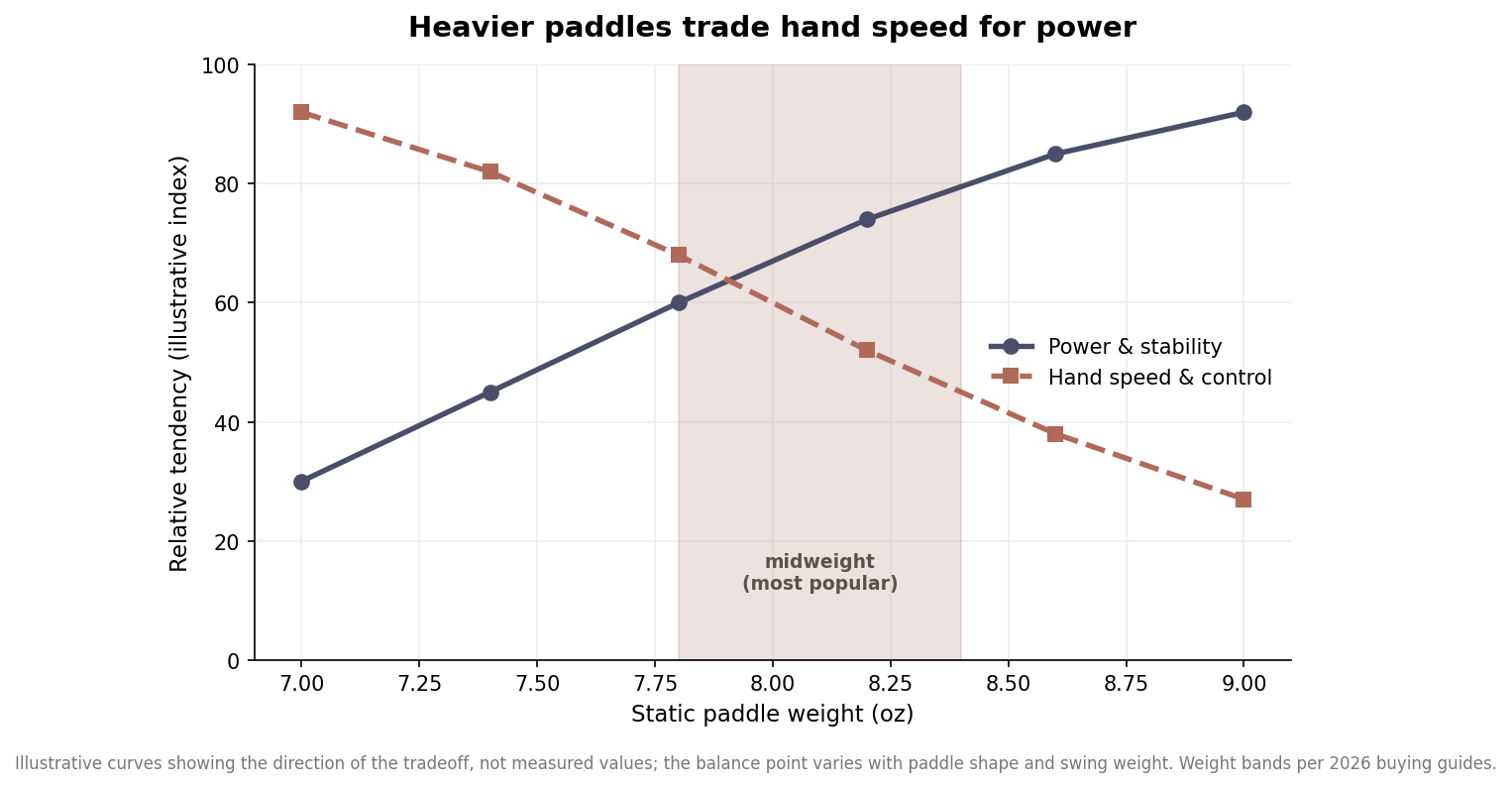
The curves above are drawn to show the direction of the tradeoff rather than measured values, because the exact balance point shifts with the paddle’s shape and how its weight is distributed. The takeaway is the crossing, not the precise numbers: somewhere in the midweight band, power and hand speed are both merely good rather than either being great, which is exactly why that band is the default. A lighter paddle asks you to supply the power yourself with faster swings, while a heavier one supplies it for you at the cost of quickness. Neither is better in the abstract; they are better for different players.
Static weight versus swing weight
The scale reading is only half the story. Static weight is what a paddle weighs sitting still; swing weight is how heavy it feels while you are moving it, and the two can diverge sharply. An elongated paddle carries more of its mass out toward the tip, so it can feel noticeably heavier through a swing than a standard-shape paddle of identical static weight. That is why a player can pick up two paddles that both read 8.0 ounces and swear one is heavier.
This matters when you are choosing from a spec sheet rather than a demo rack. A number on paper does not capture feel, and if the paddle shape is elongated or the balance is head-heavy, the effective weight in play is higher than the static figure suggests. When you cannot swing before you buy, treat an elongated or head-heavy paddle as if it sits a step up the weight ladder from its printed ounces.
Matching weight to how you play
The right weight follows from the game you actually play, not the game you admire. Players who live at the net and win with quick hands and soft resets tend to do well in the lighter part of the range, while players who win with drives, put-aways, and singles-style baseline power lean heavier for the extra pop and stability. Most recreational players are best served somewhere in the middle, which is both the safest starting point and the easiest to adjust from later.
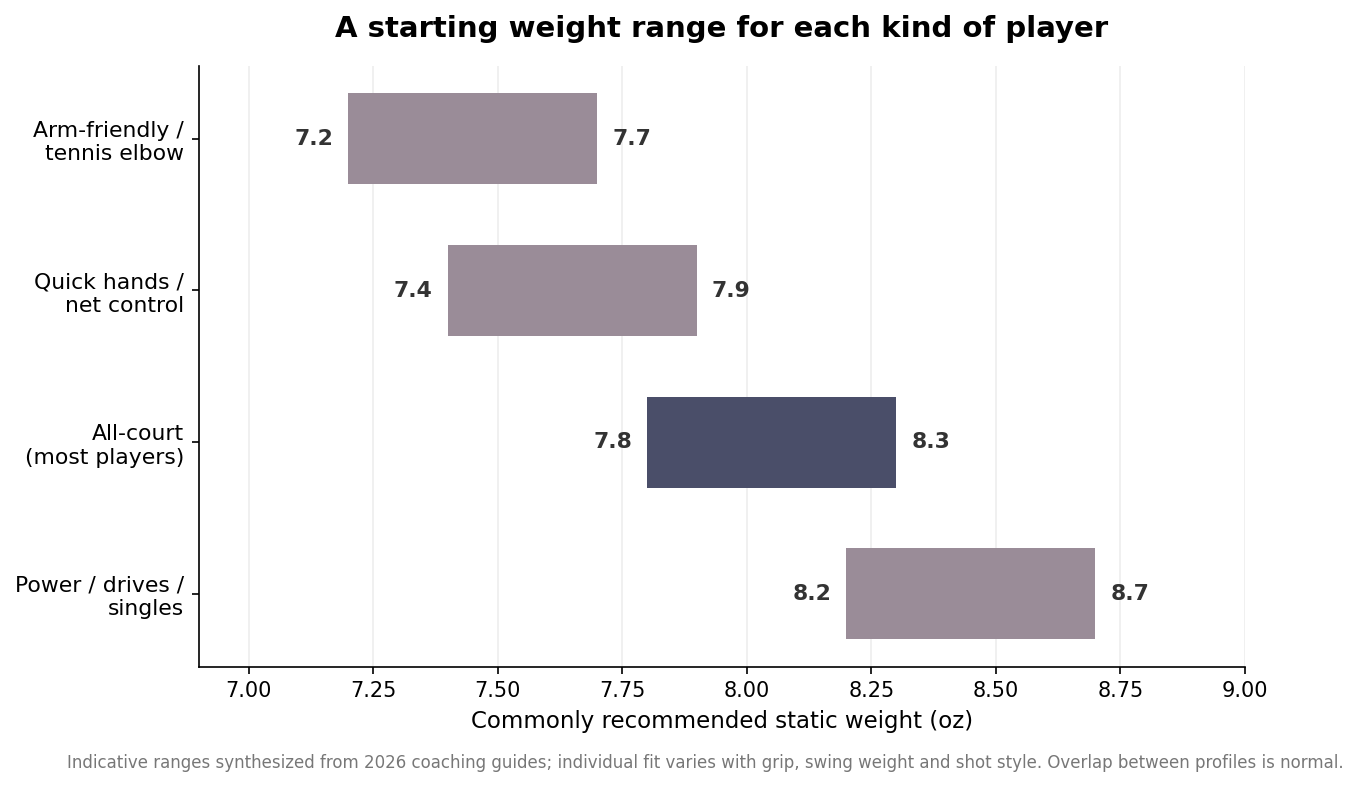
The arm question deserves its own line, because it is a real one. A heavier paddle sends more shock through the wrist and elbow on every contact, and dropping into a lighter paddle is one of the simplest ways to ease strain for a player prone to tennis elbow, a condition that affects an estimated one to three percent of adults in a given year. If a player is fighting elbow pain, the ranges above bias toward the lighter end regardless of style, and that is a trade worth making, since a comfortable paddle that stays in the bag less often beats a powerful one that hurts to use.
Tuning weight on a custom paddle
Weight is not fixed at the moment of purchase, which is good news for anyone speccing paddles for a group with mixed preferences. The common lever is lead tape applied around the edge of the face: place it near the top for a more head-heavy, higher-power feel, near the throat for a handle-heavy, quicker feel, or spread it around the rim to add overall mass and stability without shifting the balance much. A few grams changes the character of a paddle meaningfully, which lets a single base model flex toward several players.
For a club or brand ordering in quantity, the practical move is to choose a base weight slightly below your target and let players add tape to taste, since it is far easier to add mass than remove it. Decide the static weight and the balance you want as deliberately as you decide the face material and the shape, and confirm both on the spec sheet before you order. Weight is the specification players notice first and complain about most, so getting it right up front is what keeps a batch of custom paddles in hands and out of the closet.
Leave a Reply