Face material gets most of the attention when people shop for a pickleball paddle, but the specification that changes how a paddle actually plays is buried inside it: the core thickness, measured in millimeters. Two paddles with identical carbon faces and identical shapes can feel like completely different instruments if one has a 14mm core and the other a 16mm core. If you are outfitting a club, a brand, or an event and need to pick a spec that suits your players, thickness is the number to get right first. This is a straight comparison of what those millimeters do and how to choose.
What core thickness actually measures
Nearly every modern paddle is built around a polypropylene honeycomb core sandwiched between two face sheets. Core thickness is the depth of that honeycomb, and it typically runs from about 11mm at the thin, punchy end to 20mm at the thick, cushioned end. The two options that dominate the market are 14mm and 16mm, with 13mm common on power-oriented models. The chart below places the usual options on the spectrum that runs from power at the thin end to control at the thick end. The thickness is a real, measurable dimension; the power-versus-control direction is a general tendency, not a guarantee, because face material and paddle shape also pull on the same levers.
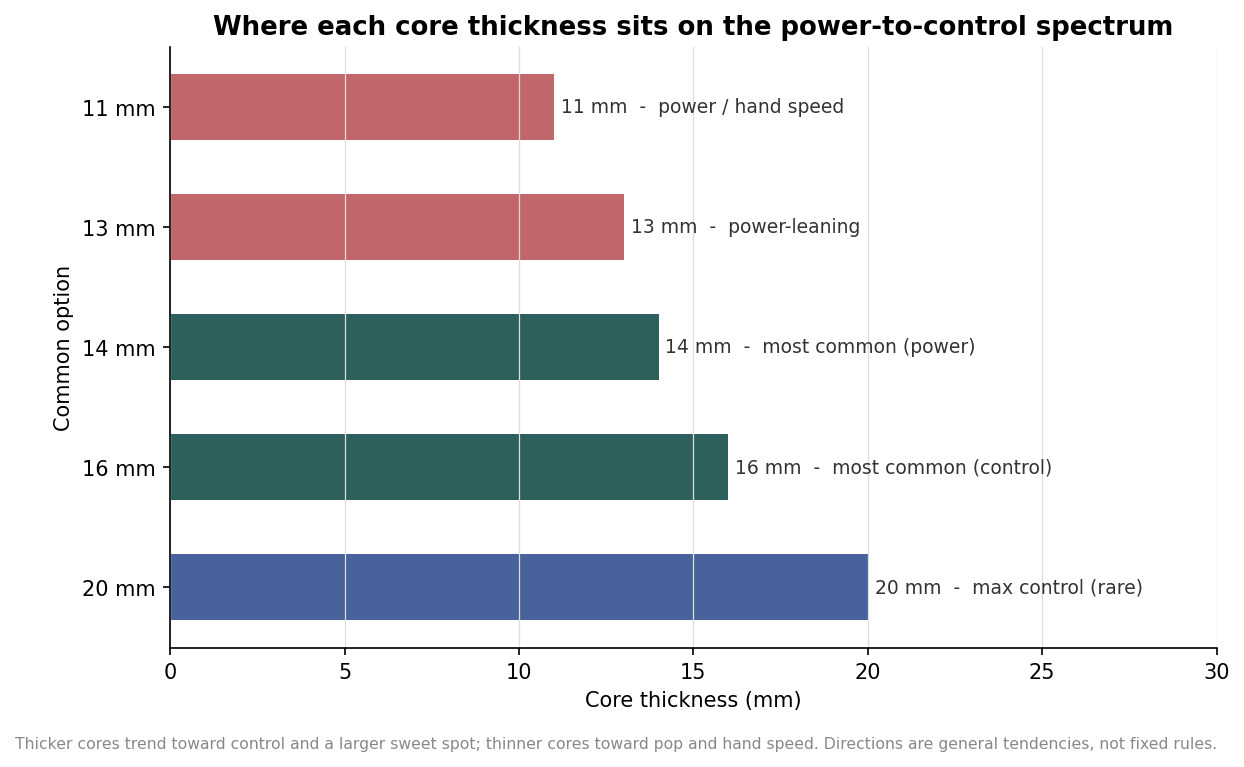
The reason thickness matters so much comes down to how the core deforms on contact. A thinner core compresses less and springs the ball back faster, which reads as pop. A thicker core flexes and absorbs more of the impact, which reads as a soft, controlled touch and a more forgiving response on off-center hits.
14mm: the power and hand-speed end
A 14mm core is the default choice for players who win points at the net with speed. It delivers more pop and a snappier, more connected feel, and because there is less material in the core, a 14mm paddle usually comes in a touch lighter and moves faster through quick hand battles. That responsiveness has a cost. The thinner core transmits more vibration to the hand, the sweet spot tends to feel smaller and less forgiving, and mishits are punished more obviously. Aggressive players and those with sound mechanics often accept that trade for the extra put-away power and reaction speed, and it is a common pick for singles play where driving the ball matters more than extended soft exchanges.
16mm: the control and touch end
Step up to 16mm and the paddle changes character. The thicker core absorbs more energy, softening the feel and expanding the effective sweet spot, which makes dinks, resets, and third-shot drops land more predictably. It also dampens vibration, which many players with arm or elbow sensitivity find easier on the joints over a long session. The trade is that a 16mm paddle gives up some raw pop and usually weighs a little more, so you work slightly harder to generate pace on drives. For doubles players who live at the kitchen line and value placement and consistency over power, 16mm is the more forgiving foundation, and it is generally the easier spec to recommend to a mixed-ability group.
Weight and the legal envelope ride along with thickness
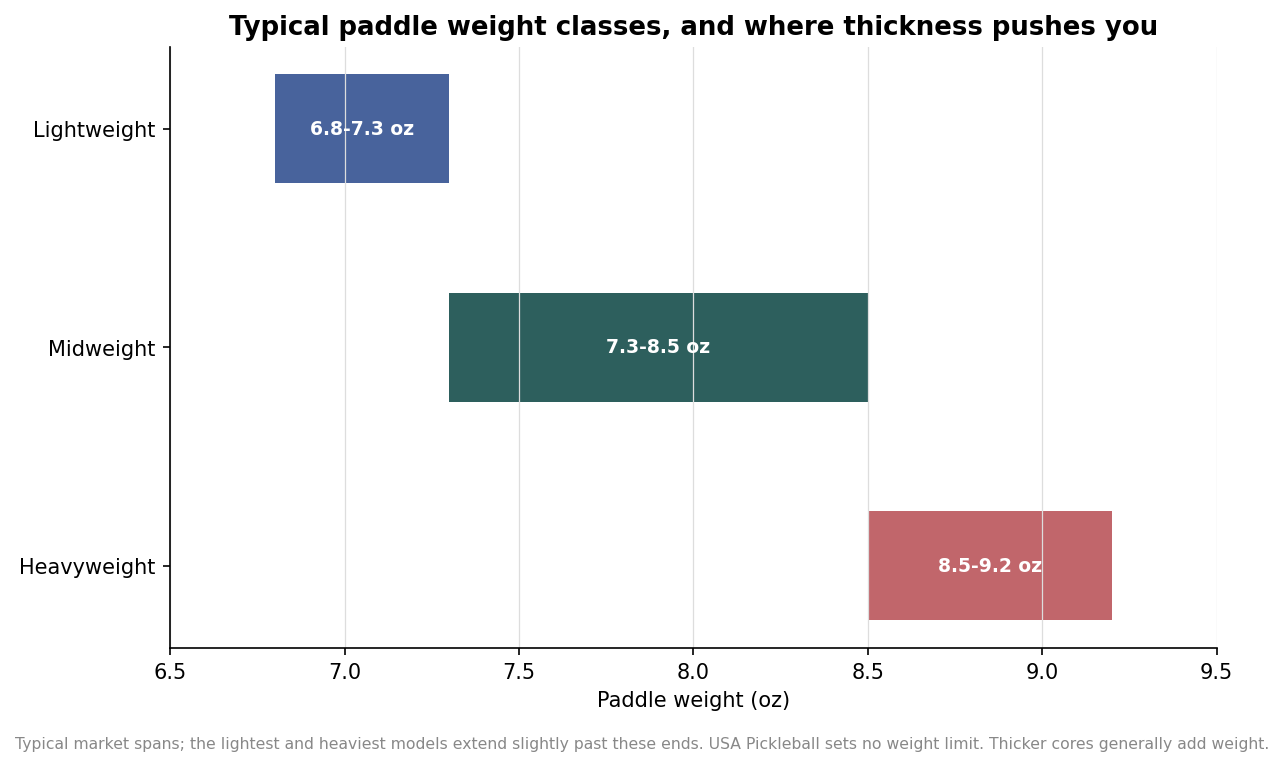
Thickness does not move in isolation. Adding core depth generally adds a little weight, so a 16mm model tends to sit higher in the weight range than its 14mm sibling. Most paddles fall between about 7.3 and 8.5 ounces, the midweight band that balances power and control, with lightweight models coming in under roughly 7.3 ounces and heavier paddles pushing past 8.5. The chart below shows the typical spans; treat the ends as soft, since a handful of models sit slightly outside them. USA Pickleball sets no weight limit at all, so weight is purely a feel-and-fatigue decision rather than a compliance one.
Where the rules do bite is on dimensions. A paddle’s length cannot exceed 17 inches, and the combined length plus width, including the edge guard and end cap, cannot exceed 24 inches. There is no official cap on core thickness, which is why 16mm and even thicker cores are legal for sanctioned play. If your paddles will be used in USA Pickleball events, confirm each model appears on the approved equipment list, since approval also depends on surface roughness and other factors the equipment standards test for.
Choosing a thickness for a group order
When you are buying for other people rather than yourself, resist the urge to chase the most aggressive spec. A 16mm core is the safer default for a broad or beginner-heavy group because the larger sweet spot and softer feel flatter a wider range of skill levels and are gentler on arms. Reserve 14mm for programs aimed at competitive or power players who have specifically asked for pop and speed. If your order is large enough to justify two versions, offering a 16mm control model and a 14mm power model covers most preferences without fragmenting your inventory. Pair the thickness decision with grip circumference, which commonly runs from 4 inches up to 4 and three-quarter inches, since a grip that is too large is harder to correct than a thickness that leans one way or the other. Whatever you choose, order a sample and let a couple of real players hit with it before committing a full run, because thickness is felt in the hand long before it shows up in a spec sheet.
Leave a Reply