Players will argue for an hour about core thickness and face material, then pick a grip size by grabbing whatever paddle is on the rack. That is backwards. Grip circumference and handle length are the two specifications your hand actually touches on every shot, and getting them wrong quietly undermines control, invites arm fatigue, and in the worst case contributes to elbow pain. If you are ordering paddles for yourself, a club, or a branded run, these two numbers deserve a deliberate decision. Here is how to make it.
Why grip size is the fit decision most buyers skip
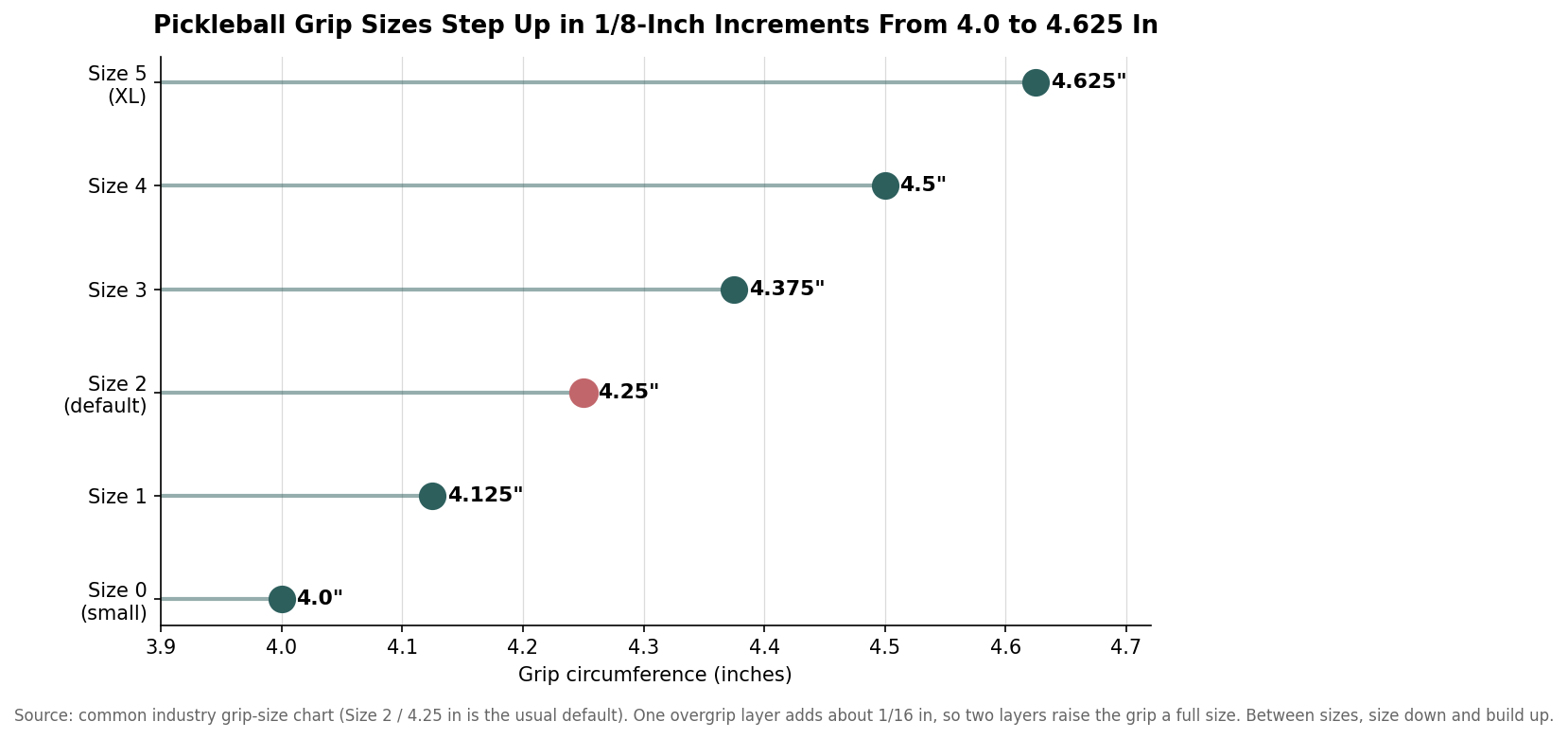
Grip size is the circumference of the handle, measured around the octagonal cross-section, and it runs in a surprisingly narrow band. The common range spans just 4.0 to 4.625 inches, stepped in eighth-inch increments: Size 0 at 4.0, Size 1 at 4.125, Size 2 at 4.25, and on up to Size 5 at 4.625. Size 2, at 4.25 inches, is the default most manufacturers ship, which is exactly why so many players end up on it by accident rather than by fit.
The stakes are higher than the small numbers suggest. A grip that is too large forces your hand to stay partly open, which reduces wrist mobility and control on touch shots at the net. A grip that is too small encourages you to squeeze harder to keep the paddle from twisting, and that constant over-gripping is a classic contributor to tennis-elbow-style strain. The right size lets you hold the paddle firmly without clenching, which is the foundation for both spin and a soft dink.
Two ways to measure the right circumference
The ruler test is the most accurate starting point. Hold your dominant hand palm-up with the fingers extended and pressed together. Measure from the middle crease of your palm, the second major horizontal line up from your wrist, straight to the tip of your ring finger. That distance in inches is a strong estimate of your ideal grip circumference. Most adult hands land somewhere between 4.0 and 4.5 inches, which is why the whole size ladder is so compressed.
The index-finger test confirms the fit on an actual paddle. Take a normal grip, then try to slide the index finger of your non-hitting hand into the gap between your fingertips and the base of your thumb. If it fits snugly with light contact on both sides, the size is right. If there is no room, the grip is too small; if the finger slides in with space to spare, the grip is too large. Between the two methods, measure first to narrow the choice, then handle a paddle to confirm.
Sizing between two numbers: go down, then build up
Because the increments are so fine, plenty of players measure to a value that sits between two listed sizes. The rule in that situation is to size down. The reason is purely mechanical: you can always add circumference, but you can never remove it. An overgrip layer adds roughly one-sixteenth of an inch, so two wraps raise the grip by about an eighth of an inch, which is one full size on this ladder. A player who buys the smaller size retains the ability to dial the fit upward with one or two overgrips and to refresh the tackiness whenever it wears. A player who buys too large has no equivalent move short of replacing the grip entirely.
This matters for custom and bulk orders too. If you are speccing paddles for a club or a giveaway where hands vary, ordering closer to the default 4.25-inch size and letting recipients personalize upward with overgrips is usually smarter than guessing large. It keeps the base paddle usable for the widest range of players.
Handle length is a separate decision from grip size
Grip circumference is about how thick the handle is; handle length is about how long it is, and the two move independently. Handles generally fall into three bands. Short handles run under 5 inches and shift weight toward the head for a punchier feel. Standard handles sit around 5 to 5.25 inches and suit most one-handed players. Long handles reach 5.25 to 5.5 inches and beyond, with some models pushing toward 6.
The decisive question is whether you hit a two-handed backhand. That stroke needs enough handle to seat both hands without the lower hand spilling onto the paddle face, which in practice means a handle of at least 5.25 to 5.5 inches. Anything shorter forces the off hand onto the hitting surface, costing control and feeling awkward. A longer handle also acts as a longer lever, adding a little head speed and moving the balance point toward your hand for a more maneuverable, head-light feel.
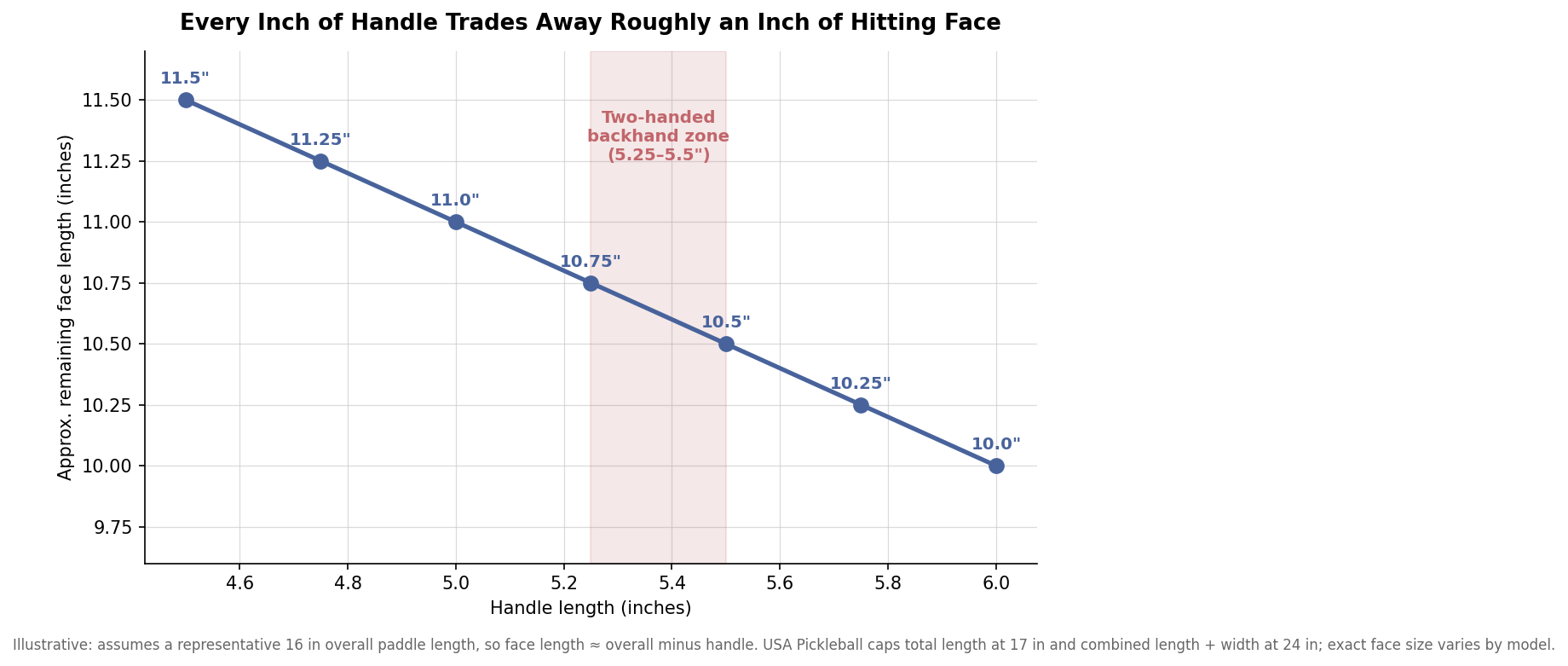
There is a real trade-off on the other side. Under USA Pickleball rules, a legal paddle’s combined length and width cannot exceed 24 inches, and total length is capped at 17 inches, so every inch you add to the handle is an inch subtracted from the hitting face. The chart below illustrates the relationship on a representative sixteen-inch paddle: a 4.5-inch handle leaves roughly 11.5 inches of face, while a 5.5-inch handle leaves closer to 10.5. A shorter face means a smaller and slightly lower sweet spot, which is the price a two-handed player pays for room to hold on.
Specifying grip and handle for a custom order
Decide the two numbers before anything cosmetic. Settle grip circumference by measuring the intended player’s hand or, for a mixed group, defaulting to 4.25 inches with the expectation that overgrips will fine-tune it. Settle handle length by asking a single question: does this player, or this population of players, hit two-handed backhands? If yes, spec 5.25 inches or longer and accept the modestly shorter face. If the group is mostly one-handed and values a larger sweet spot, a standard handle around 5 inches serves them better.
Only once those are fixed does the rest of the build make sense, because grip and handle interact with everything else you choose. A long handle paired with a head-heavy weight will feel very different from the same handle on a head-light paddle, and a small grip on a heavy paddle magnifies twisting forces on off-center hits. Lock the fit dimensions first, confirm them against a real sample in hand, and the paddle you order will play the way you intended rather than the way the default rack happened to be set up.
Leave a Reply